Author: Meg Costa

Using Advocacy to Create Greater Community Impact

On Thursday, Feb. 15, leaders from across North Texas’ nonprofit sector joined United Way of Metropolitan Dallas for Advocacy for Greater Community Impact, a special webinar that explored the role of advocacy in improving access to education, income and health in our community.

2024 is a critical year for public policy in Texas, as we approach the November election and prepare for next year’s legislative session. United Way is encouraging every individual and community organization to speak up in support of policies and candidates that will benefit our region.

Our advocacy webinar explored key topics designed to empower community organizations to add advocacy to their strategies for the year, including:

  • The various types of nonprofit organizations and what kind of advocacy and lobbying activities are permitted under the law
  • How nonprofits across Texas can mobilize our collective advocacy and impact, especially at the state level
  • Tips and strategies for developing an advocacy agenda
  • How nonprofits can partner with lawmakers to advance policy for greater community impact

Hillary Evans, vice president of policy and advocacy at United Way of Metropolitan Dallas, opened the event by explaining why United Way is focused on and enthusiastic about advocacy—particularly during a big election year.

“Here at United Way, we believe and the power of unity to create lasting change,” she said. “As a social change organization entering our second century of impact, we are leading a movement to improve education, income and health—what we call the building blocks of opportunity—so all North Texans can thrive. One of the critical ways that we can create greater access to opportunity is through our advocacy efforts at the federal, state and local levels.”

The event featured a panel discussion with some of our community’s leading change agents, each of whom has extensive experience with the power of advocacy:

  • Ashley Harris, director of public policy and advocacy, United Ways of Texas
  • Vince Leibowitz, legislative director and fiscal analyst for the office of State Sen. Royce West
  • Natalie Roetzel Ossenfort, program director for Bolder Advocacy at Alliance for Justice

Lindsey Hughes, finance counsel at Haynes and Boone and co-chair of the United Way of Metropolitan Dallas Advocacy Committee, served as moderator.

View a video for the full event below, or read on for highlights from the Q&A.

Lindsey Hughes: Natalie, could you go into detail on what kind of activities might be acceptable and how organizations can remain nonpartisan, especially when we’re in an important election year?

Natalie Roetzel Ossenfort: You are not allowed as a 501(c)(3) to support or oppose candidates for public office. This does include public offices that are not party specific. So for example, when people run for city council in Dallas, they’re not declaring what party they’re affiliated with—these are non-partisan offices. But because they are public elected offices, we should not suggest who people should vote for or against or what parties they should vote for or against. This also includes things like school boards. When we have school board elections, you don’t want to chime in as a 501(c)(3) in terms of who the best candidates are.

Obviously under these rules you can’t endorse a candidate. That would be a clear violation of the 501(c)(3) rules. But you can do things like nonpartisan voter engagement work—for example, if you want to get out the vote, educate voters about how to find their polling location or what type of ID they need to bring with them to the polls. That’s something that is going to be 501(c)(3) safe, but it has to be done in a non-partisan way. So it’s really this balancing act, and you’ve got to figure out what risk level you’re comfortable with as a 501(c)(3).

Hughes: Ashley, United Ways of Texas represents individual United Way organizations all across the state, including working with us in North Texas. Can you talk to us a little bit about ways your organization leverages collective advocacy?

Ashley Harris: Advocacy really is a pillar of United Way, as it’s a key component to making lasting change and communities. As a network of Texas United Ways, we really believe in the power of community voices in policy and advocacy. We believe that state leaders need to hear from local nonprofits and their partners, as you are uniquely positioned to speak up on behalf of your community. You’re doing this work every day, and we believe your voice is essential to policy discussions.

I think it’s important to remember that advocacy is a continuum that can also include lobbying. Where a lot of our United Ways focus their advocacy is on educating and creating awareness among legislators and other decision makers about particular issues that their communities are facing.

As an example, we host a Capitol Day every year where our United Ways bring their networks, partners, volunteers and donors together around critical issue areas to remind policy makers what’s most important to Texas communities. It’s an opportunity to highlight the power of our network and the power of community voice.

Hughes: We will now move on to chat with Vince, whose kind of got the opposite perspective working in a public office. Texas is unique, in that we have our legislative session every other year. Could you talk to us a little bit about the timeline in the legislative session and what to think about in terms of advocacy in an off-session year?

Vince Leibowitz: The first thing you would probably ask is who exactly am I advocating to? You’re advocating to more than one person at once: legislative staff, committee chairs, legislators themselves. And then you ask, where does the advocacy happen? Most of it’s going to happen in Austin, but some legislators do not maintain an office presence in Austin during the off years and their entire office is centered within their district. So you may find them within their district. The last question is how you reach the people, and I’m about to tell you the most important thing about that.

Please make appointments. Legislative staff, particularly during legislative session, sometimes take up to 15 meetings a day, dozens and dozens of phone calls on top of all of the actual duties that we’re doing on the floor of the ledge of the Senate with our boss or in committee meetings. So the best way to get staff’s attention is actually to make an appointment and not just to drop by. The ways to reach folks are by phone, by email and in person. I recommend you do in person after you have set things up by phone and email.

When do you start your advocacy in advance of the next legislative session? You always start the day after the legislative session ends. It doesn’t matter if the legislature rolls on into special sessions. The legislature has a two-year lifecycle with the interim and session, and you have a limited window during that time to prepare to accomplish your legislative goals.

I also encourage everyone on this timeline to start narrowing your focus to specific areas of advocacy. We have some organizations that will come and hand us a legislative agenda that has 400 items in it. No organization can handle working on 400 items. Make certain that you are realistic and narrow your advocacy to specific areas that actually match your organization’s mission. For example, if your organization is an animal welfare organization, you do not need to be advocating on things that are outside of animal welfare unless it affects animal welfare.

Add to Your Advocacy Toolbox

Interested in ramping up your advocacy efforts this year? Check out these resources for additional information on allowable advocacy activities, courtesy of the Alliance for Justice:

Advocate with Us

Whether you are part of a North Texas nonprofit or simply a community-minded resident, we invite you to advocate with the Live United network. When we speak up, united, we have the power to drive lasting change in our community.

Sign up for our Advocacy Alerts, and we’ll let you know how and when to contact your representatives to have the biggest impact possible.

Your Guide to the March 5 Election

It’s that time again: Election Day is fast approaching. This year’s primary and general elections could have a significant impact on North Texas, as our elected officials determine policy that charts the future of education, income and health in our region.

At United Way of Metropolitan Dallas, we encourage every eligible North Texan to turn out for our community and vote in the March 5 primary election. That’s because casting your ballot during every election is one of the easiest, most effective ways to have a meaningful impact on life in North Texas.

This Year’s Elections Are Extremely Important

While it’s important to vote in every election, this year’s primary and general election are especially significant.

That’s because a variety of powerful positions are on the ballot—including president, U.S. senator and Texas Board of Education members—each of whom will make policy decisions that will most likely have an effect on your day-to-day life.

The candidates elected to these seats also have the power to directly impact education, income and health in North Texas, which means this is not an election you will want to sit out. Voting is one of the simplest, yet most powerful, duties we as citizens hold. And it’s a surefire way to advocate for policies and changes that are important to you.

Want to have a say in how property taxes are spent? Eager to help decide who is on the school board? Be sure to cast your ballot in every election.

Your vote has the power to improve the quality of life in North Texas and drive positive changes that affect the education, income and health of our community.

A Look at What’s on the Ballot

During the March 5 primary election, voters will select their party’s candidate for numerous local, state and federal races, including:

  • President
  • U.S. senator
  • Three Texas Supreme Court justices
  • Five Appeals Court justices
  • Seven Texas Board of Education members
  • 15 state senators
  • Texas railroad commissioner
  • A variety of local county offices, including sheriffs, district attorneys and tax assessor-collectors

Your district may include additional races. To see all the races and issues on your ballot, visit Vote411.org and type in your home address.

And for more detailed information about what will appear on your ballot, visit your county’s election site:

Primary Elections and Party Affiliation

The Republican and Democratic parties are both holding their primary elections on March 5 to choose nominees for the November general election. On that day, voters can only vote in one party’s primary election. But you don’t have to vote for the same candidate or party in the general election.

How does party affiliation work in Texas?

When you sign up with a party, that affiliation is good until Dec. 31 of that year. You can do this by voting in a party’s primary, swearing in at a precinct convention or taking a party loyalty oath. Once you’re affiliated with a party, you can’t vote in another party’s primary in the same year.

If you haven’t affiliated with a party yet this year, you’re basically a free agent and can vote in either the Democratic or Republican party. But once you’ve hitched your wagon to a party, you’re affiliated with them until the year runs out. You’ll have to wait until next year if you want to switch parties.

Know Before You Go

Verify your registration. If you’re unsure whether you’re registered to vote, you can check on the Texas Secretary of State website. (Not registered? Unfortunately, you missed the Feb. 5 deadline. But you can visit VoteTexas.gov to register now for the November general election and for any run-off elections.)

Avoid delays by voting early. During a presidential cycle, election day can be extremely busy. Luckily, in Texas early voting runs Tuesday, Feb. 20 through Friday, March 1. You’ll be able to find early voting locations by using the search site Am I Registered?, which will be populated with voting sites a few days before early voting begins.

Bring a photo ID: You must present one of the seven acceptable forms of photo identification before you can vote:

  • Texas driver’s license
  • Texas election ID certificate
  • Texas personal ID card
  • Texas handgun license
  • U.S. citizenship certificate with photo
  • U.S. military ID card with photo
  • U.S. passport (book or card)

Your voter registration card is not mandatory to vote, but it’s a good idea to bring it if you have it. If your name is spelled differently on the official voter list than on your ID, showing your registration card may resolve the issue.

Voting locations: Polling locations may be different for early voting and Election Day, so visit your county’s election website—Dallas, Collin, Rockwall or Denton—to make sure you’re headed to the right location.

Be an educated voter: Save yourself time at the polls by being prepared. Do your research on candidates, and determine how you want to vote before getting to the voting machine. You can bring notes or a sample ballot with you to vote, but you’re not allowed to have partisan flyers with you in the voting booth. Create your own personalized ballot by visiting Vote411.org.

Encourage your network: Make a plan to vote. Then, invite your neighbors and friends to go vote with you.

Vote by mail: To be eligible to vote early by mail in Texas, you must meet at least one of the following criteria:

  • Be 65 years old or older
  • Be disabled
  • Be out of the county on Election Day and during the period for early voting by personal appearance
  • Be confined in jail, but otherwise eligible

You can request the application for a mail-in ballot from the Texas Secretary of State’s office. The deadline to submit a vote-by-mail application is Friday, Feb. 23. To learn how to request a vote-by-mail application and to submit your application, visit your county’s Elections Office website: Dallas, Collin, Rockwall or Denton.

If you decide to vote by mail, be sure to have your ballot postmarked by 7 p.m. on March 5.

Voter Rights in Texas

As a voter, it’s helpful to understand your rights so that you feel comfortable and confident in voting this year. Check out our Texas Voter Bill of Rights before you cast your ballot.

Creating Job Opportunities in an Unpredictable Labor Market

The start of a new year brings countless predictions for what the next 12 months holds in terms of the economy, inflation, job growth and more. Although many experts disagree on what 2024 will bring, it’s likely that job gains will cool significantly this year.

Unfortunately, this trend may mean fewer job prospects for North Texans looking to find work, increase their salary or take the next step in their careers. And low income has a direct impact on the rest of a worker’s life. For example, when a person’s job opportunities are limited, they are less likely to achieve financial security, which can limit their children’s success in school and negatively impact their family’s health.

At United Way of Metropolitan Dallas, we have done significant research on the North Texas labor market to identify good jobs in growing industries. Armed with this deep understanding, we invest in comprehensive training programs to enable hard-working North Texans to earn short-term industry certifications that lead to good-paying employment in targeted sectors, including IT, healthcare and construction.

Supporting workforce development initiatives is a key part of our mission to improve access to education, income and health—because a living-wage job is fundamental for any individual or family to thrive.

Read on to learn more about job and wage growth predictions for the new year, how a lack of job opportunities impacts North Texans, and how United Way and our partners work together to improve access to living-wage jobs.

Fewer Job Opportunities in 2024

Most experts agree that the U.S. will add far fewer jobs in 2024 compared to last year, as consumer spending declines and the economy cools.

In 2023, payroll employment rose steadily, averaging 225,000 new positions nationwide per month. But for 2024, that monthly average could be anywhere from 53,000 to 100,000, depending on who you ask. Meanwhile, there is a chance the unemployment rate—currently at 3.7%—could rise as fewer companies hire new workers.

For North Texans who are looking for a job or hoping to make more money this year, these trends could limit their opportunities and have a very real impact on their day-to-day lives.

A Lack of Job Opportunities Hurts North Texans

When a community lacks job opportunities, it can be a struggle to find a living-wage job. In a tight job market, workers are more likely to live below the poverty line, many can’t afford stable housing, and their families’ health and educational prospects suffer.

In our state, hundreds of thousands of individuals are struggling because of limited access to good-paying jobs. The median household income in Texas between 2017 and 2021 was $67,321, and $74,580 nationwide in 2022. That means overall, Texans are making quite a bit less than their counterparts in other states. Workers of color, on average, tend to make even less than white workers.

As a result, our state has a relatively high poverty rate. According to the latest data from the Census Bureau, 14% of Texas’ population of roughly 30 million people are living in poverty. This is well above the national average of 11.6%, which totals 37.9 million Americans living below the poverty line.

Meanwhile, the cost of living has increased over the last few years as the price of housing, food and other necessities has risen. According to the Massachusetts Institute of Technology’s living wage calculator, a childless adult living in Dallas County needs to make $18.24 an hour to cover basic expenses and have a little money saved for emergencies. This number jumps to $35.74 if that person has a child. Just a few years ago, these hourly living wages were significantly lower—$15.98 for a childless adult and $31.94 for an adult with one child. Although inflation overall has started to fall, the cost of living in our community is still quite a bit higher than it was a few years ago, while wages have remained relatively level.

Each of these statistics tends to affect workers of color more acutely. Greg Mangum, vice president of economic mobility at United Way of Metropolitan Dallas, says workers of color in North Texas tend to have fewer pathways to good-paying jobs available. Plus, they’re more likely to have their careers impacted by external factors, such as access to childcare, transportation and digital literacy skills.

“Since the pandemic, everything has gotten more expensive, but unfortunately wages haven’t kept up with inflation or consumer price increases,” Mangum said. “And the workers in our community are up against enormous odds to find stable, good-paying jobs. That not only holds back individuals and their families; it holds back our entire community. It takes all of us working together to create and improve pathways to living wage jobs so every North Texan can prosper.”

United Way Creates Pathways to Better-Paying Jobs

Income is an area that affects our entire economy. When more North Texans prosper, our region as a whole enjoys greater prosperity.

At United Way of Metropolitan Dallas, income is one of our areas of focus, because we understand the positive impact of financial stability and a good-paying job on every part of a person’s life. We continually research the local labor market to identify strong job opportunities in growing industries. Working with our community partners and investors, we invest in and support comprehensive workforce training programs that enable individuals to quickly earn industry certifications that open pathways to steady employment in fields such as healthcare, IT, transportation and logistics, and construction.

One of our Aspire United 2030 goals—our North Star for driving progress in the areas of education, income and health over the next decade—is to increase by 20% the number of young adults who earn a living wage. Reaching that milestone will add nearly $800 million to our local economy.

To advance that goal, our workforce development initiatives include:

  • Pathways to Work: A partnership with 36 community organizations that provides fast-track industry certifications that lead to good jobs in growing industries, such as IT, construction and healthcare. Through United Way’s investment in Pathways to Work and related Community Impact Grants, in the last year more than 20,000 North Texans had access to job skills training and resources and nearly 3,000 were placed in new and better jobs.
  • Dallas Technology Training Consortium: Funded through a grant from the City of Dallas, the consortium provides IT and technology skills training to individuals impacted by the COVID-19 recession. The program serves 630 Dallas residents over a two-year period, in partnership with Goodwill Industries of Dallas, NPower and Per Scholas.
  • CSW Workforce Benchmarking Network: United Way is part of the Workforce Benchmarking Network (WBN), which brings together community-based organizations, public and private funders, and other intermediaries that provide workforce development services around the country to support better results for job seekers, employers and communities. Led by CSW (Corporation for a Skilled Workforce), the network improves the availability of quality data and information about the labor market, programs and practices. It also builds the capacity of local service providers to use that evidence to develop more effective services and policies.
  • Career navigation: United Way recently supported a career navigator position with our community impact partner WiNGS. As a key member of the organization’s Financial Empowerment Centers, the navigator will provide guidance to local workers seeking to explore, participate in and complete job skills training programs that lead to sustainable employment with a living wage and benefits. They will also coordinate referrals to supportive services and community assistance programs to ensure participants have the support necessary to complete their education.

Join Us in Supporting a Stronger Workforce

A strong workforce benefits all of North Texas by strengthening our economy, improving educational outcomes, lowering healthcare costs and more.

We invite you to join our movement and create opportunity for all North Texans. You can have a direct impact on workforce development in our region by:

  • Making a donation to United Way, which will support workforce development initiatives like the ones outlined above.
  • Volunteering for one of our workforce development initiatives. Throughout the year, United Way and our partners hold volunteer opportunities that strengthen our workforce. Right now, you can volunteer to introduce local students to a variety of career opportunities. Visit our January volunteer page to get started.
  • Advocating with us. This is an important year for public policy changes, with a presidential election and several significant local ballot measures. Sign up for our Advocacy Alerts to learn how and when to advocate with us and other change-seekers across North Texas.

United Way and AT&T Host ‘UnCharitable’ Screening to Inspire Innovative Thinking Among Nonprofits, Corporate Partners

As the trusted corporate social responsibility (CSR) partner for dozens of corporations across North Texas, United Way of Metropolitan Dallas plays a pivotal role in mobilizing a wide variety of stakeholders toward a common goal. We lead a community-wide movement to improve access to education, income and health, bringing together the corporate, philanthropic, civic and nonprofit sectors, as well as individual change-seekers, to achieve strategic goals for North Texas.

But how can United Way and our supporters continue to maximize our investments and impact? This question was one of the topics we explored on February 7, when we joined AT&T to host a screening of “UnCharitable,” a powerful new documentary from producer Dan Pallotta that uncovers the realities of nonprofit work and introduces a radical new approach to philanthropy. Pallotta, an entrepreneur and author, is well known for his incredibly popular TED Talk, “The way we talk about charity is dead wrong.”

The film highlights the need for change-seekers to think big to drive positive change —in part by adopting methods used by for-profit organizations, such as embracing risk, advertising their impact, and focusing less on overhead and more on results. The screening left United Way of Metropolitan Dallas and our community partners eager to incorporate even more innovative approaches in our work to improve access to education, income and health in North Texas.

Following the film screening, the evening included a Q&A with Pallotta led by Charlene Lake, Chief Sustainability Officer and Senior Vice President of Corporate Responsibility at AT&T, and immediate past chair of the United Way of Metropolitan Dallas Board of Directors.

The documentary advocates for a radical reformation in philanthropy, urging social impact organizations to break free from traditional constraints to enact real change. As one of United Way’s most generous corporate partners, AT&T has long supported innovation and ambition in our community impact work. For example, we worked closely with AT&T to develop Digital Bridges, an innovative targeted initiative that improves access to digital technology in Southern Dallas. The company also was instrumental in the launch of our flagship social innovation program, the Social Innovation Accelerator, and made the inaugural investment in the program in 2013.

As Lake explains, creating measurable, lasting change in our community requires an innovative mindset—and the willingness to embrace big ideas.

“AT&T is a big believer in bringing bold solutions to solve our community’s biggest challenges,” she said. “We’re proud of the collaboration we have with United Way and the other nonprofits who are in this room. And together, we’ve driven positive impact in our communities. But there’s so much work that has to be done. If we’re going to solve big problems in our communities, we collectively need to be stronger; we need to be bolder.”

For AT&T and dozens of other North Texas corporations, United Way is a trusted CSR partner that represents a smart, strategic and measurable way to invest in the future of our community.

As “UnCharitable” demonstrates, a substantial shift is underway in the nonprofit and philanthropic sector. At United Way, we’re grateful to be able to take part in this positive transformation that promises to uplift North Texas and communities across the globe.

Missed the Event? How to See ‘UnCharitable’

If you are a change-seeker who is invested in the future of our community, “UnCharitable” promises to inspire and change your thinking. The film will change your perceptions of philanthropy, giving and how to build a world that works for everyone.

As Pallotta points out, “UnCharitable” has the power to change the way everyone associated with a nonprofit—its employees, board members, donors and partners—thinks about that organization and its mission.

“The biggest thing you can do is get everybody on your staff [to see it],” Pallotta said. “Don’t make the assumption that everybody on your staff is already persuaded. … Get everyone on your board to see it, then get your major donors to see it. Then keep educating them until you start to feel that you have a culture that’s really entrepreneurial, that’s really thinking differently, that really gets this stuff. And you’ve got to reinforce it.”

If you missed our screening, there are two ways to see the documentary:

  • Host your own screening for a nonprofit, campus or community group. Click here to learn more.
  • View it once it’s available on streaming platforms, which Pallotta expects to be this summer. (In the meantime, you can watch Pallotta’s insightful and inspiring TED Talk, a foundation of the documentary, here.)

Pallotta also offers a special training opportunity for nonprofits, The Bolder Board Training, which teaches board members how to work with their CEOs to create bolder, more audacious possibilities for impact. Click here for details.

Learn More About Partnering With Us

United Way of Metropolitan Dallas is proud to partner with companies of all sizes to drive lasting change in North Texas. We have the relationships, data and expertise to help you build and strengthen your culture of good citizenship and corporate social responsibility.

Interested in learning more? Visit our Partner With Us page to discover some of the ways we work with corporate partners and to connect with our team.

Affordable Connectivity Program Significantly Expands Broadband Access

At United Way of Metropolitan Dallas, we’re raising awareness about the Affordable Connectivity Program (ACP), a valuable initiative that has expanded high-speed internet access for tens of millions of Americans.

Expanded broadband access directly supports our three focus areas: education, income and health. That’s because reliable internet enables students to succeed in school, workers to find and keep good-paying jobs, and North Texas families to access online health resources.

Unfortunately, the future of the ACP is uncertain. In this blog, we want to share two critical pieces of information:

  1. If you’re eligible to sign up for the ACP, the deadline to do so is Wednesday, February 7. Keep reading for more information.
  2. If you’re interested in supporting expanded broadband access in our community, we invite you to advocate with us in support of ACP. Read on to learn how to best voice your support.

What is the Affordable Connectivity Program?

In 2021, Congress approved the ACP to support Americans struggling to pay for internet service. The ACP helps ensure households can afford the broadband they need for school, work, healthcare and more.

The program provides two key benefits:

  • Up to $30 per month toward internet service for eligible households and up to $75 per month for households on qualifying Tribal lands
  • Up to $100 to purchase a laptop, desktop computer or tablet from participating providers, if they contribute more than $10 and less than $50 toward the purchase price

The ACP is limited to one monthly service discount and one device discount per household.

Since the program launched, more than 20 million Americans have signed up—representing a significant expansion of high-speed internet access in our country. However, nearly 30 million people who are eligible have not signed up. Whether they are unaware of the program or simply haven’t gotten around to signing up, these Americans are leaving money on the table.

“Reliable, high-speed internet access used to be a luxury, but today it is a necessity that enables people in our community to utilize the education, financial security and healthcare tools and resources needed to thrive in our digital age,” Hillary Evans, vice president of policy and advocacy at United Way of Metropolitan Dallas. “The ACP is an important step toward improved digital access, which is one way that we can ensure more of our North Texas neighbors can thrive.”

What is going on with the future of the program?

Unfortunately, current funding for the ACP could expire as early as April. However, a proposed bill, the Affordable Connectivity Extension Act of 2024, would provide additional funding to extend the program. The bill has been referred to Congress’ Appropriations Committee for consideration.

How do I sign up?

Visit onlineforall.org/enroll to apply right away. Remember, February 7 is the last day that the ACP will accept new applications and enrollments to receive the financial benefit until the program ends.

I’m already signed up. What happens if the program ends?

If Congress doesn’t vote to provide additional funding, the ACP will run out of money around April. Currently, the Federal Communications Commission, which coordinates the ACP, expects consumers that are enrolled in the program to continue to receive their full benefit on their internet service through at least April.

If your household is enrolled in the ACP, you should receive a notice from your internet provider in late January or February regarding your bill and possible other options. For more information, view the FCC’s FAQs about the wind-down of these ACP funds.

Voice Your Support for ACP

Supporting greater digital access through programs like ACP is a sure-fire way to improve access to education, income and health—the building blocks of opportunity—in our community.

As one ACP client named Thelma shared, affordable internet has been life-changing for her.

“If it had not been for the ACP program, I would not have internet,” she said. “It’s in my house. I don’t have to go anywhere. If the weather’s bad outside, oh well, it doesn’t affect me. I can still plug into the internet and learn what I want to learn.”

You can voice your support for ACP by asking your representatives to pass the Affordable Connectivity Extension Act and continue funding this important program.

Here are four steps to advocate for the Affordable Connectivity Extension Act today:

  1. Find out who represents you using the Texas Tribune’s “Who Represents Me?” tool.
  2. Contact your congressional leader and ask them to co-sponsor the Affordable Connectivity Program Extension Act. Make sure to cite the bill number (HR 6929/S. 3565). Not sure what to say? Reference this simple talking point guide.
  3. Share your support for ACP on social media. Check out this advocacy social media toolkit for sample posts, and be sure to tag your congressperson so they see how important ACP is to you and your community.
  4. Join a coalition of nonprofits, including United Way Worldwide, in a letter to congressional leadership urging continued funding for the ACP to ensure families and children have access to affordable broadband. Add your name here.

Join Us in Supporting Access to Education, Income and Health in North Texas

By supporting initiatives like the Affordable Connectivity Program, we can all expand access to education, income and health in our community.

As healthcare, education and commerce become increasingly digital, communities need high-speed internet. We work to close the “digital divide” between communities that have adequate internet access and those that do not. The digital divide disproportionately affects people in rural areas, older adults, people of color, households with low incomes, people with disabilities, veterans and older adults.

Together, we can ensure all North Texans have the opportunity to thrive. We invite you to invest in lasting change by making a one-time or recurring donation to United Way of Metropolitan Dallas today.

Checking in on Progress Toward Our Aspire United 2030 Goals

At United Way of Metropolitan Dallas, we just released our newest Impact Report, which explores how supporters like you made a positive impact for 1.6 million North Texans—or more than 20% of our region’s population—in our 2022-2023 fiscal year.

How does that incredible impact affect our mission in North Texas? Let’s take a closer look at the goals that we are working toward, how we measure progress and what the latest data reveal about education, income and health in our region.

Our Aspire United 2030 Goals

As we lead and invest in programs that improve access to education, income and health across North Texas, we keep a close eye on our progress so we know we’re truly making an impact.

At United Way, we know it’s not enough to create a one-time impact in someone’s life. To drive real, lasting change, we focus on challenges that have kept generations of North Texans from truly thriving. And to create lasting change, we know we must quantify our goals and closely track our progress.

We collaborated with a broad spectrum of community partners to develop the Aspire United 2030 goals: our North Star for driving transformational change in education, income and health across North Texas through the year 2030:

  • Increase by 50% the number of students reading on grade level by third grade.
  • Increase by 20% the number of young adults who earn a living wage, adding more than $800 million per year to the local economy.
  • Increase to 96% the number of North Texans with access to affordable healthcare insurance.

Every 10 years, we reassess and refine our goals to address new challenges and opportunities. As we continue the march toward our Centennial year and our second century of service, setting 10-year goals enables us to ensure we always remain effective.

Evaluating and Tracking Our Goals

Setting and closely tracking quantifiable 10-year goals and leveraging a third-party evaluator are key differentiators in our unique approach to community impact work.

We track progress toward our Aspire United 2030 community goals through our partnership with the Parkland Center for Clinical Innovation (PCCI), an alumnus of our Social Innovation Accelerator.

Since PCCI’s Accelerator experience, the team has gained a rare degree of expertise in leading healthcare topics, including social determinants of health, and has pioneered ground-breaking solutions to more effectively identify needs, prioritize services, empower providers and engage patients in Dallas County and across the country. Meanwhile, PCCI has honed its expertise in defining and measuring near, mid- and long-term successes, and how to communicate impact. As a result, they were an ideal organization to help United Way track progress toward our community-wide Aspire United 2030 goals.

Progress Toward Our Goals

Curious about how our work—and your support—impact education, income and health in our region? Read on for an overview of the most recent data on our key impact measures in each area, or click here to view our latest Aspire United 2030 report. (These are the newest datasets available, and they do not necessarily reflect our most recent progress in these areas.)

Education

Third-grade reading proficiency decreased an average of 8% (from 55.59% to 47.43%) when compared to the prior year, based on 2021 Texas Education Association data. While decreases were seen across our entire service area, the greatest decline was observed in Dallas County (-10%).

We can attribute this to the ripple effects of the COVID-19 pandemic and its profound impact on early childhood learning. During the height of the pandemic, North Texas students experienced months of school disruption and uncertainty that led to significant learning loss—and many young scholars are still recovering.

This 2021 data indicates that progress toward our Aspire United 2030 goals is even more critical than it was before the pandemic. To ensure children are set up for success in school, our education programs include:

  • Once Upon A Month™: This early literacy program delivers free age-appropriate children’s books and parental reading guides to families every month, stimulating curiosity, language development and learning skills—all of which set kids up for success in kindergarten. In our last fiscal year, United Way and our supporters provided nearly 130,000 free books to more than 11,000 local families.
  • Heal Play Learn: Made possible by a grant from Texas Instruments Foundation, this partnership with Educate Texas delivers hands-on learning opportunities to students in Lancaster, DeSoto and Cedar Hill school districts to encourage social and emotional wellness, physical activity, creativity, collaboration and critical thinking skills. Last summer, 670 students participated in 75 hours of hands-on programming.
  • Healthy Outcomes through Prevention & Early Support (HOPES) and Texas Home Visiting Program: These parent education initiatives provide families with hands-on instruction, community resources and skills that empower parents, encourage healthy child development and prevent child abuse. Last fiscal year, 885 families participated in a home visiting program.

Income

All counties in our service area saw a small improvement (about 2%) in the percentage of adults earning a living wage, as reflected by 2019 American Community Survey data. Rockwall County experienced the greatest increase, at 3.2%.

By investing in North Texans through job training and certification programs, we can ensure more of our neighbors have access to living wage jobs. The vast majority of low-wage jobs (such as retail, hotel/food service, construction, transportation warehouse/manufacturing and healthcare support) are filled by individuals with a high school degree or less, and they provide an annual salary of around $32,000 per year. With additional education, average salaries increase by about $20,000 a year, which can have a transformative impact on a person’s entire family, supporting their children’s success in school and enabling them to access high-quality healthcare.

To create pathways to better-paying jobs for more North Texans, our financial stability programs include:

  • Pathways to Work: This workforce development program, in partnership with 36 community organizations, gives hardworking North Texans the training necessary to secure jobs in IT or healthcare. Last year more than 20,000 North Texans participated in Pathways to Work programming, which led to 1,870 degrees or certifications and nearly 3,000 job placements.
  • Dollars for College: This partnership with Communities Foundation of Texas seeds college savings accounts for low-income students, making them significantly more likely to attend and graduate college. In 2022-2023, our supporters enabled us to open 166 new college savings accounts and deposit more than $140,000 for low-income students.
  • Housing Stability: We work to prevent homelessness in North Texas by creating programs and forming strategic partnerships that encourage housing stability. In 2022-2023, this work provided more than $3.8 million in rent and utility assistance to nearly 600 households. We also advocated for affordable housing and continued our leadership of the Dallas Rental Assistance Collaborative, which provides rental and utility assistance to keep families in their homes during challenging economic times.

Health

There was essentially no change in the percentage of individuals with health insurance coverage, as reflected by the 2019 American Community Survey. However, Texas is typically one of the worst states in the nation in terms of health insurance adoption, and lack of health coverage disproportionately impacts Black and Hispanic families, especially those with young children. Without health insurance, families often forego care or pay out of pocket, which can negatively affect their financial stability, hurt children’s performance in the classroom and limit adults’ earning potential.

However, Texas is seeing improved rates of insured individuals overall. Our state had nearly 570,000 new signups for affordable health care plans in 2023—the largest jump in the nation—and North Texas was a leader in that growth.

At United Way, our Healthcare Navigators program helped to make health insurance more accessible for thousands of North Texans. This collaborative program provides a network of certified Healthcare Navigators for the North Texas community, delivering support for individuals and families looking to sign up for health insurance through the Marketplace, Medicaid or CHIP. Navigators work directly with clients to help them compare health plans, understand benefits and apply for subsidies to lower their monthly premiums. In our last fiscal year, Healthcare Navigators fielded 52,133 client inquiries and supported 6,703 individuals as they signed up for CHIP/Medicaid and an additional 1,250 as they enrolled in a qualified health plan.

We also expand access to health resources in our region through programs such as:

  • Food access initiatives: Part of our work to improve food security involves supporting and amplifying summer meals programming to provide regular, nutritious meals to children who qualify for federally funded nutrition programs. In summer 2022, this program supported summer meals providers as they served more than 55.6 million regular, nutritious meals to 143,000 children in Dallas and Collin counties.
  • Doorways to Health: This community partnership seeks to improve the maternal health outcomes of women in Dallas. Doorways to Health offers a variety of resources and programming, including home visiting and holistic maternal healthcare services, to ensure new and expecting mothers have the support necessary to thrive. In 2023, 326 pregnant people accessed resources through Doorway to Health providers. The partnership also hosted informative community events with hundreds of attendees to highlight the importance of maternal healthcare during Black Maternal Health Week.

Change Lives with Us

In the years since these datasets were gathered, United Way of Metropolitan Dallas and our supporters have only expanded our impact in North Texas. Last year, we changed the lives of nearly 1.6 million of our neighbors, and we’re poised to continue deepening that impact this year.

We invite you to be part of the change and help us drive progress toward our community-wide Aspire United 2030 goals:

  • Invest in United Way. Make a one-time or recurring gift to directly support programs that improve access to education, income and health right here in North Texas.
  • Volunteer with us. Engage directly in community impact by signing up as a volunteer for an upcoming project, such as the Point in Time Homeless Count or Reading Day.

Meet our 2023 Social Innovation Incubator Fellows

The 2023 cohort of our Social Innovation Incubator is underway, and we’re excited to introduce you to the nine social entrepreneurs who are participating in this groundbreaking program that provides support and resources as they launch, fine-tune or build their innovative ventures.

Read on to learn more about the Incubator and how it supports our mission to improve access to education, income and health; discover how our partners are creatively advancing this incredible initiative; meet our nine fellows; and learn a bit about how they’re leading changing lives in their communities.

Building the Social Innovation Pipeline

At United Way of Metropolitan Dallas, social innovation is part of everything we do to improve access to education, income and health. Over the past 10 years, we have emerged as a leader in this space, supporting and amplifying the work of social entrepreneurs who are creating measurable impact in North Texas.

Most recently, we created the Social Innovation Incubator, an organizational and leadership development program designed exclusively for early-stage social ventures. Through our 14-week program, we build up innovative startups while reducing gaps in resources and opportunity.

The Incubator provides participants with mentorship and guidance that empowers them to create a validated business plan and begin building their ventures. The initiative also establishes a stronger pipeline of ventures that are ready for the Accelerator program.

Collaborating for Greater Impact

The 2023 Social Innovation Incubator will be done in partnership with three talented community partners—Dallas College, Southern Methodist University and eqALL—that support, invest in and provide resources to North Texas social entrepreneurs.

Dallas College delivers full access to an entrepreneurial community with their new Dallas College Venture Club, where each fellow also enjoys a free dedicated workspace. SMU’s MADI Program brings to the Incubator a unique approach to human-centered design, teaching methods and techniques for creative problem solving and business development, while eqALL steers the program’s strategic processes to drive connection and access to resources.

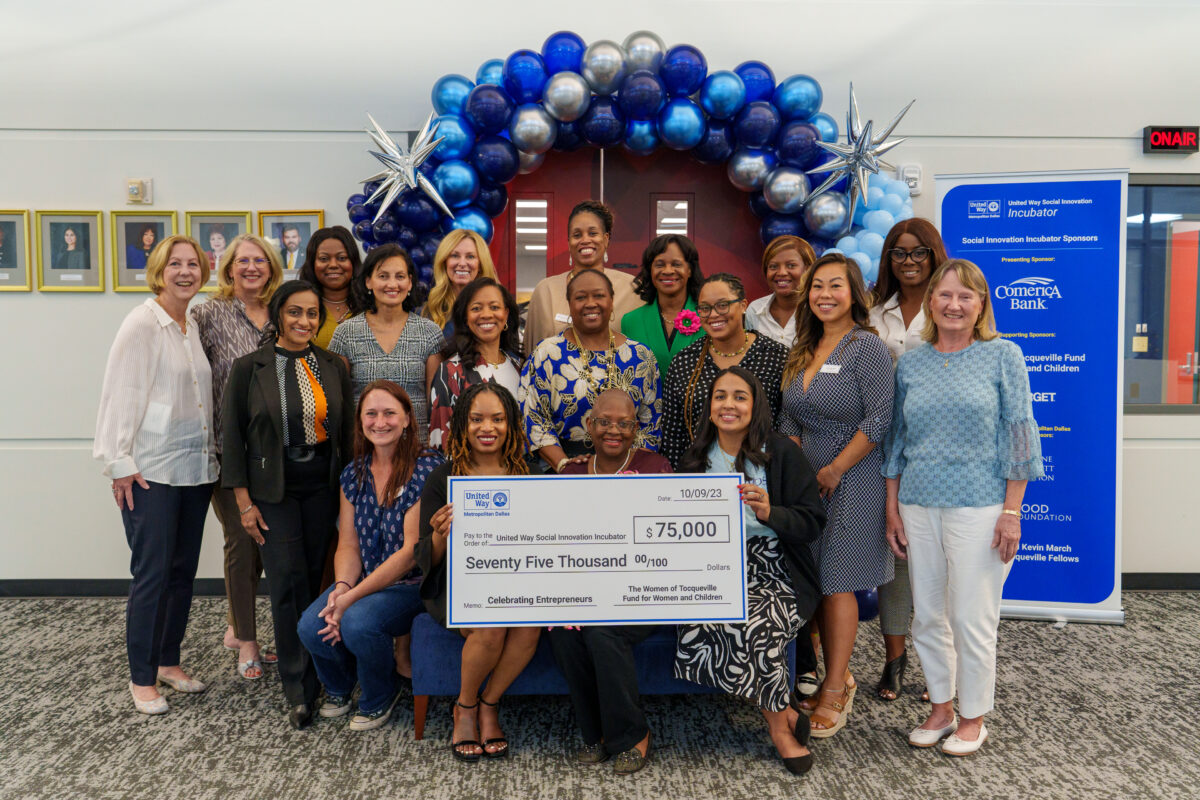
Our list of dedicated Incubator partners also includes Comerica Bank, The Women of Tocqueville Fund for Women and Children, Eugene McDermott Foundation, Target and Charles Schwab, each of which is dedicated to creating lasting change in our community by providing vital investments for programs like the Incubator.

The United Way Women of Tocqueville Fund for Women and Children, which delivers targeted financial and skill-based investments in education, income and health. In 2022 and 2023, the fund’s Advisory Council voted to invest in the Incubator, providing entrepreneurs with the funding and resources necessary to build their ventures and grow their impact.

The United Way Women of Tocqueville are also directly involved in the success of each cohort. These dedicated change-seekers volunteer their time to serve as mentors for our Incubator participants, driving further progress toward their goal to improve access to education, income and health.

Meet the Entrepreneurs

The 2023 cohort of the Social Innovation Incubator will go through a 14-week learning program in which they will validate their business plan, receive personalized leadership coaching and seed funding, and set their venture up for future success.

This year’s cohort includes nine entrepreneurs with bold visions for improving access to education, income and health in North Texas:

Sydney Portilla-Diggs, Any Step Community Services

Any Step Community Services assists seniors in the Dallas Metroplex by providing nonperishable food. The organization launched the Healthy Steps Recipe Kit Program to distribute simple recipes developed by a nutritionist team, with a goal of educating participants on how to turn food bank items into healthy meals and how to shop for healthier items. Any Step also hosted and launched a Health/Wellness series of workshops and seminars with their partner UT Southwestern, and they are developing an emergency preparedness protocol for older adults.

Cameka Robertson, FASTell Girl

FASTell Girl focuses on holistic health for at-risk girls. Using their BET System, the organization tackles behavior management, offers exposure through mentoring, and provides tutoring for academic and life skills. FASTell empowers girls to manage emotions and behaviors, reduce school-related stress and foster resilience for healthier futures.

Laura Hayes, The Learning Bridge

The Learning Bridge has developed a computer game that teaches college preparedness skills and persistence habits to underrepresented students. By designing, developing and improving on prototypes of their useful gaming system, The Learning Bridge seeks to entice youth to use their gaming time to learn skills and habits that will benefit them in college and beyond.

Monique Brewer, Parent2Parent Café

Parent2Parent Cafe creates community through cafés, meeting monthly to discuss the highs, lows and in-betweens of parenting and providing nonjudgmental care and concern. Additional educational offerings include informational workshops for a variety of everyday needs for parents, including job resources, career mobility, resume writing, self-care, conflict resolution and financial education.

Alicia Serrato, Primos Dallas

Primos is a nonprofit mentoring organization based in Dallas that pairs young students with Latino professionals. Primos’ goal is to foster family-like relationships among mentors and mentees and their families. Their mission is to empower students and their families to tackle any challenge through mentoring and exposure opportunities. In addition to mentoring, Primos also offers workshops, connections to internships and scholarships.

Joanna Lam, Project Beauty

Project Beauty seeks to help their clients break cycles of abuse, rebuild self-esteem and confidence, and improve their health and overall standards of living. They have partnered with local shelters to provide beauty pamper days and beauty bags so clients can access services like haircuts, facials, massages and makeup applications for important life events. They also support children living in shelters as they prepare for school by providing haircuts and other essential self-care services.

Tryrikia Banks, Royalty Health Inc.

Royalty Health Inc. provides healthy living from the inside out by teaching holistic healing, providing mental health resources, assistance with physical needs such as activities of daily living, respite care to help families work while their loved one is taken care of, transportation to medical appointments and assistance with medication. Our goal is to help patients understand that healing comes from within mentally, physically, emotionally and spiritually.

Tamera Jackson, Rootines App

Rootines is a data and analytics platform focused on pediatric complex chronic conditions that seamlessly connects parents to clinicians and care teams. They currently have solutions for NICU follow-up, autism and mental health. The Rootines platform is available on Android, iPhone or through the web via a desktop. It is designed to reach parents and families where they are, which promotes health equity.

Cetarracca Rockwell, Unstudios Technology

Unstudios Technology provides a user-friendly platform where clients and customers who are seeking assistance from social organizations and support programs can complete assessments and receive personalized resource recommendations. The technology seeks to improve access to vital support services and opportunities that can benefit an individual’s life.


Support Social Innovation in North Texas

This is an exciting time to step up and be part of our community’s social innovation movement. We invite you to be a part of the change by supporting the Social Innovation Incubator, which in turn supports innovative organizations that are changing lives in their communities.

Together, we can create opportunity for all North Texans to thrive. Donate today to support our social innovation programs.

Expanding Food Access—and Building Community—in Southern Dallas

Last month marked an inspiring moment for the communities of Southern Dallas.

On Saturday, Oct. 28, our North Texas neighbors came out in force to celebrate the opening of the new Community Market, the latest venture from Empowering the Masses. The market will address food insecurity in the surrounding residential areas, while also helping to foster a vibrant community in a location that has experienced historical disinvestment.

This exciting initiative is a partnership of Empowering the Masses, United Way’s Southern Dallas Thrives initiative and Goodr Co., which delivers hunger relief solutions. By expanding the availability of nutritious, quality food in Southern Dallas, this work advances our mission to improve access to education, income and health so all North Texans can thrive.

Read on to learn more about the significance of Southeast Dallas’ newest food access location, our longstanding partnership with Empowering the Masses and how together with our partners we’re providing vital investment opportunities to the Southern Dallas community to create lasting change and measurable impact.

A Historical Location—with a Bright Future

The location of the new Community Market brings an additional layer of significance and impact for the families of Southern Dallas.

Samuel Boulevard is named after the esteemed Dr. William Samuel, a renowned physician, civic leader and philanthropist. Unfortunately, the street is burdened with more than a dozen liquor stores within a 3-mile stretch, plus check-cashing stores and other businesses that don’t necessarily reflect the priorities of the community.

But today Samuel Boulevard is becoming a hub for positive transformation, bringing a sense of hope and excitement to our neighbors in both Southern and Eastern Dallas. Empowering the Masses’ Community Market is the first of its kind on Samuel Boulevard, providing crucial resources to uplift the most valuable asset in Southern Dallas: its residents.

Fostering Community in Southern Dallas

Tammy Johnson, founder and executive director of Empowering the Masses, wanted to enable more of her neighbors to break out of the cycle of poverty. She began Empowering the Masses as a grassroots organization focused on providing basic needs services in a way that cultivates a sense of understanding and dignity for community members.

As part of their work, Johnson and her team established a small community pantry to improve food access in Southern Dallas; however, they quickly went from providing free, nutritionally balanced meals to 35 families per month to now serving more than 1,400 families per month. Before long, it was clear that Empowering the Masses needed a larger space to close the gaps of food insecurity of many Southern Dallas households.

Johnson says the new Community Market will enable her organization to make an even greater impact in the Southern Dallas communities than she would have thought was possible.

“With this expansion, we aim to extend our reach even further, providing essential resources and a higher-quality shopping experience to the people of Southern Dallas,” she said. “This grand opening represents our commitment to fostering a vibrant and thriving community, where every individual has the opportunity to receive the vital services they need with dignity.”

In addition to its work to improve food access, Empowering the Masses also offers innovative medical training and certification programs that provide pathways to sustainable and lucrative healthcare careers, empowering individuals to enhance their earning potential to foster resiliency and self-sustainability. They also collaborate with local health organizations to offer health screenings and related services to their neighbors.

César Fotso, a previous client who is now a training partner of Empowering the Masses, started out as a volunteer for the organization. He found out that they were offering free phlebotomy technician classes, so he enrolled. After passing the national certification exam, César is now working in one of the biggest hospitals in North Texas.

“Through Empowering the Masses, I earned complete financial independence, and I’m able to feed my family,” he explained. “Empowering the Masses is an organization where they place human beings at the first level as a priority—they place the dignity of people first. The love they use to care for people, to help people to get back on their feet, is just incredible. I just feel loved, I feel happy and I feel encouraged to come back and help others to get back on their feet as well.”

Collaborating for Greater Impact

United Way embraces unity as a key part of our strategy. We partner with corporations, community organizations, school districts, foundations, individual change-seekers and more, leveraging a collaborative approach to yield the greatest results.

Our collaborative strategy includes targeted impact initiatives, such as Southern Dallas Thrives, through which we work with corporate partners to make targeted investments and collaborate on place-based programs that prioritize community-centric impact.

United Way also partners with local community organizations that engage directly with the communities in which greater investment will have the most impact. Additionally, through our Social Innovation Lab, we provide vital investment, mentoring and resources to social entrepreneurs with bold new ideas for improving education, income and health in our community.

Working together, we drive progress toward our community-wide Aspire United 2030 goals to ensure that more children are graduate high school ready to succeed, more workers can find can keep good-paying jobs and more families can access the health resources necessary to thrive.

Empowering the Masses illustrates the power of these collaborations.

Our partnership with Empowering the Masses began in 2020 by way of Southern Dallas Thrives, in an effort to address many of the emergency needs faced by Southern Dallas communities as a result of the COVID-19 pandemic. From that initial investment and subsequent partnership, Empowering the Masses continued to broaden its areas of focus to include workforce development programs and expanded its pantry operations to serve more families.

As Empowering the Masses scaled its work with Southern Dallas Thrives, the organization continued to grow and our partnership expanded. In 2021, Empowering the Masses become a United Way community impact partner. Johnson then went through United Way’s Social Innovation Accelerator and was named “Social Innovator of the Year” at its culminating event, The Pitch. The Community Market is the next evolution community-based partnerships, and it is poised to have a significant impact in Southern Dallas.

Southern Dallas Thrives Creates Lasting, Holistic Change

As a partner on the Community Market initiative, Southern Dallas Thrives is supporting Empowering the Masses’ expanded impact in Southern Dallas, increasing the number of neighbors and residents they can serve.

Created in partnership with PepsiCo/Frito-Lay North America, United Way’s Southern Dallas Thrives Initiative provides vital investment opportunities within Southern Dallas communities to create lasting, measurable impact. The initiative takes a holistic approach to improving access to education, income and health by addressing the multifaceted challenges faced by under-resourced and underinvested communities in Southern Dallas. Through collaborative efforts with organizations like Empowering the Masses, United Way and our partners are positively influencing the economic trajectory for many of our neighbors.

“Improving access to organizational support and investments in the impact areas of education, income and health is our key focus and priority within Southern Dallas Thrives,” said Ashley Douglas, vice president of the Southern Dallas Thrives Initiative. “Our partnerships with place-based organizations like Empowering the Masses have enabled us to expand how we address challenges, identify collaborative opportunities and economically impact our most valuable but vulnerable communities and sectors. Amplifying the work of partner organizations while providing targeted investments that directly focus on the southern sector is a key component of our work, and it shapes how we view and implement community-centric trust-based philanthropy.”

Over the years, Southern Dallas Thrives’ food access efforts have intentionally focused on reducing barriers to food accessibility and opportunity with dignity at the forefront. As our partnership with Empowering the Masses and Goodr continues, together we will continue to provide opportunities for Southern Dallas neighbors to thrive.

Join Us in Expanding Food Access

At United Way, we recognize that food insecurity is a community problem, and it requires a community-wide solution. We invite you to join our movement and help expand access to quality, nutritious food.

As we approach the holiday season, there are two easy ways to get involved:

  • Give: Investing in United Way of Metropolitan Dallas is one of the most impactful ways to create positive change right here at home. When you make a donation today, your gift can help fund initiatives like Southern Dallas Thrives and the Social Innovation Accelerator, which support the work of grassroots organizations and social entrepreneurs who are making a measurable difference in their communities. Click here to give now.
  • Volunteer: This month, you can fight food insecurity by volunteering with us to assist at a local food pantry. Click here to learn more.