Author: Meg Costa

Volunteers Will Promote Early Literacy by Reading to More Than 15,000 Students on United Way Reading Day

United Way Reading Day presented by Atmos Energy is one of our most beloved annual traditions. As part of our Aspire United Volunteer Series presented by Texas Instruments, it’s a unique opportunity for community volunteers to spark a love of reading in young students across North Texas.  

This fun-filled day directly supports our goal to improve third-grade reading proficiency in our communities. Early literacy is important for all children and is foundational to our three focus areas—education, income and health—which we’ve identified as the building blocks of opportunity.   

As we look ahead to United Way Reading Day presented by Atmos Energy, held Friday, March 7 in more than 1,000 classrooms across North Texas, let’s explore the impact of Reading Day, the importance of reading proficiency and how you can be part of this incredible event. 

We Created an Unprecedented Impact in 2024 

Last year’s United Way Reading Day presented by Atmos Energy was bigger, more exciting and more impactful than ever before. The event, celebrated in more than 1,000 classrooms across North Texas, engaged nearly 1,200 dedicated volunteers who read to more than 20,000 local students. 

With thousands of change-seekers signing up to read to children, donate books and prepare literacy kits, Reading Day 2024 marked the kickoff of our Aspire United Volunteer Series presented by Texas Instruments, leading up to this year’s Centennial anniversary. Now through November, we’re uniting all of Dallas to celebrate our first 100 years of impact, give back to the community and look ahead to our next century of service to North Texas. 

This historically impactful event inspired hand-raisers from across North Texas to get involved, including Former First Lady Mrs. Laura Bush, who served as honorary Reading Day chair.  

United Way Reading Day even got a shoutout on the Today Show, where Jenna Bush Hager was leading her own celebration of Read Across America Day while her mom Laura read to excited kiddos right here in North Texas. Check out the clip here! 

Reading Day 2024 Impact 

  • 20,000+ local students positively impacted 
  • 1,200+ volunteers engaged  
  • 1,000 classrooms participated 
  • 42 elementary campuses celebrated 
  • 4,400 literacy kits prepared by our corporate partners  

For Reading Day volunteers like Dr. Harryette Ehrhardt, the event was an opportunity to leverage the power of books to change lives. The former educator—who even taught children’s literature to our Honorary Reading Day Chair Laura Bush at Southern Methodist University—knows that reading is the gateway to a child’s future. 

“You can use a book to go anywhere in the world, any time, any place in history,” she says. “And to give children that resource is to give them something to carry on with their lifelong learning.” 

The Importance of Reading Proficiency 

Our annual Reading Day celebration isn’t just about encouraging children to love reading. It also supports early literacy by showing kids that books are fun, accessible and engaging.  

Early literacy is directly connected to our focus areas of education, income and health—the building blocks of opportunity. When children develop strong reading skills, they are better equipped to succeed in school, which in turn supports college and career readiness, career achievement and even overall health.  

Research shows the connection between education and other key areas: 

  • Children who enter school ready to learn are more likely to read proficiently by third grade.  
  • College graduates can earn $36,000 more a year, enabling them to save for the future. 
  • Financially stable adults can access quality healthcare for themselves and their families.  

Research indicates that third grade is an important learning milestone for students and a time when reading proficiency is especially significant. That’s because third grade is when children shift from learning to read to reading to learn. From this point on, reading becomes foundational for all other learning, including science, math and history. In fact, an estimated 85% of all curricula is taught by reading. 

“Once children develop strong literacy skills, they are ready to begin learning and succeeding in every subject,” said Abigail Sharp, vice president of early childhood initiatives at United Way of Metropolitan Dallas.  

While events like Reading Day support children’s development, creativity and vocabulary, they also create a foundation for learning, which opens the door to the future, whether that takes the form of college, a career, the military or some other path. By encouraging early reading as a community, together we can advance our mission to create access and opportunity for all North Texans to thrive. 

Reading Proficiency in North Texas 

Recent data shows that third-grade reading proficiency has jumped more than 15% in our service area. This puts us on track to achieve our top-line Aspire United 2030 education goal, which is to increase by 50% the number of students reading on grade level by third grade.  

Our community wide Aspire United 2030 goals are our set of 10-year benchmarks guiding our impact in the areas of education, income and health now through 2030. Together with our independent external evaluator, the Parkland Center for Clinical Innovation (PCCI), we closely track progress toward our Aspire United 2030 community goals.  

Sharp says early literacy initiatives like those from United Way of Metropolitan Dallas and our partners are having a direct impact on overall third-grade reading proficiency in our community. 

“United Way and other local community organizations recognize the importance of literacy and exposure to reading from a very early age,” she says. “Programs like United Way Reading Day and Once Upon a Month create opportunity and access where it didn’t exist before, exposing children to the joys and possibilities of books in a way that will benefit them for years to come.” 

Support Early Literacy in North Texas 

Research indicates that by the end of third grade, 74% of struggling readers won’t ever catch up. That’s why it’s so important for children to have literacy opportunities and exposure as early as possible.  

Here are three ways you can support early literacy in right here at home: 

  1. Volunteer: Join us as a Reading Day volunteer, either by signing up to read to students in person or by participating in one of our virtual volunteer opportunities. This year’s Reading Day will celebrate 100 Years of Reading, in recognition of United Way’s Centennial anniversary. Volunteers will read to thousands of elementary students across North Texas classrooms and participate in our online book drives to help build each child’s personal library. To learn more about United Way Reading Day and to volunteer, visit our Reading Day event page.  
  2. Give: Make a donation to support programs like Reading Day and Once Upon a Month, which delivers age-appropriate children’s books to North Texas children every month to encourage language development and spark a love of reading. 
  3. Advocate: The Texas Legislature is currently in session, and now is the perfect time to join us in advocating for our legislative priorities, which include strengthening early literacy policies. Sign up for our Advocacy Alerts today. 

United Way Explores Socio-Economic Challenges and Opportunities at Dallas Fed Global Perspectives Speaker Event

On Jan. 16, United Way of Metropolitan Dallas and the Federal Reserve Bank of Dallas welcomed community leaders and change-seekers to the latest event in the Dallas Fed’s Global Perspectives Speaker Series. The signature speaker series features engaging conversations with business leaders, economics and policy experts and Federal Reserve officials.

The event was an opportunity for United Way to come together with some of our leading supporters to discuss strategies for improving access to education, income and health right here at home. 

Insights From a Mission-Driven Entrepreneur 

This month’s event included a conversation with Daniel Lubetzky, founder of Builders and KIND Snacks, moderated by Lorie Logan, president and CEO of the Federal Reserve Bank of Dallas and member of United Way’s CEO Advisory Board.  

Lubetzky is a social entrepreneur focused on empowering people to work across divides to solve our toughest problems together. He brought insight to a variety of important topics, including:  

  • His experience creating and leading mission-driven organizations 
  • His strategy of building bridges and using market forces to try to bring people together  
  • The importance of uniting key stakeholders within a community to drive meaningful change 
  • The role of entrepreneurs and the private sector in achieving positive outcomes for a community 
  • How individuals can get started in creating a fairer, more equitable society 

Click below to view the Global Perspectives event video on-demand. 

We Unite the Community to Drive Socio-Economic Change 

As Jennifer Sampson, McDermott-Templeton president and CEO of United Way of Metropolitan Dallas, pointed out in her welcome remarks, United Way’s mission to improve access to education, income and health aligns with the Dallas Fed’s community development work, which promotes economic growth and financial stability for low- and moderate-income communities and individuals. 

“Our mission at United Way is simple but powerful: to improve lives across North Texas by mobilizing the caring power of our communities and by investing in education, income and health,” Sampson said. “Since 1924, we’ve brought together community leaders, nonprofit partners, corporations and individual philanthropists to improve lives because we know that when we come together in this community, we are the heartbeat of North Texas. “ 

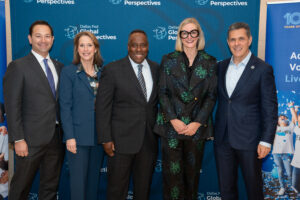
Jason and Laura Downing, Steven Williams, Jennifer Sampson and Daniel Lubetzky

“The values of the Fed are also the values of United Way of Metropolitan Dallas and our work here in North Texas,” she continued. “The heart of our work is connection, collaboration and driving solutions together alongside this community.” 

As we work to advance our community-wide Aspire United 2030 goals, we unite stakeholders from across North Texas to drive socio-economic change, focusing on bi-partisan business, political and philanthropic partnerships to drive enduring collaborative change.   

A special thanks to everyone who made this engaging evening possible, including Daniel Lubetzky, the Dallas Fed, and Laura and Jason Downing, co-chairs of the United Way Ruth Sharp Altshuler Tocqueville Circle.  

Save The Date for Our Centennial Celebration 

Be sure to save the date for our Centennial Celebration on Nov. 15, when our Centennial year culminates in a massive celebration at Fair Park, chaired by Christy and Steven Williams of PepsiCo. The day will feature a food and wine festival, a VIP dinner and a concert in the Cotton Bowl with Super Bowl-level entertainment. It’s set to be the event of the year! 

Learn more about our year of Centennial events. 

3 Strategies for Advocating in Support of Affordable Housing

At United Way of Metropolitan Dallas, the issue of housing is foundational to our focus areas of education, income and health—because no North Texan can thrive in these three pillars if they lack stable, secure housing. 

Throughout the current 89th Texas legislative session and beyond, one of our legislative priorities is to advocate for policies that will increase the supply of affordable housing and promote housing stability for low-income workers and families.  

You don’t need to be a housing or advocacy expert to be part of this important work. To encourage change-seekers like you to speak up and speak out in support of affordable housing, we partnered with the research firm Topos to create an easy-to-use advocacy toolkit, which provides step-by-step instructions on how to advocate for narrative change around housing.  

Download your copy of our affordable housing advocacy toolkit, or read on for key takeaways that you can use to support your advocacy work.  

The Importance of Affordable Housing 

When our neighbors have access to affordable housing, they are better equipped to thrive in every area of life. With a stable, secure home, students are more likely to succeed in school and avoid frequent moves; workers are more likely to stay employed and save money for the future; and families are more likely to stay safe and healthy.  

Unfortunately, a lack of affordable housing and rising rent and mortgage costs across North Texas are making it more challenging than ever for our neighbors to find and maintain stable housing. According to The State of Dallas Housing: 5-Year Comparison Report—which was prepared by buildingcommunityWORKSHOP and sponsored by United Way of Metropolitan Dallas, The Dallas Foundation and The Meadows Foundation—since 2016, there are fewer homes valued at our around $100,000 making affordable housing stock out of reach for low-to moderate-income homebuyers. 

Meanwhile, in the last few years, average rents have reached an all-time high.  According to Child Poverty Action Lab’s 2024 Rental Housing Needs Assessment for the city of Dallas, the median rent is unaffordable to 71% of residents. 

This means more of our neighbors are struggling to balance rent, bills and other financial responsibilities. For many North Texans in this situation, it becomes impossible to keep up with a high rent or mortgage payment, which can lead to homelessness—a significant concern in our community. More than 3,700 individuals experience homelessness in Dallas and Collin counties alone on a given night, according to the 2024 Housing Forward State of Homelessness report.   

However, our region can begin to shift these trends by embracing more affordable housing. Together, we can advocate for policies that will expand access to affordable housing and encourage other change-seekers to support housing that is smaller, is smarter and includes greater variety. Read more here about how the Texas legislature could tackle affordable housing this session, and check out this newly released report by the Bush Center proposing a federal policy agenda to address housing affordability.  

Why We Need to Talk About Affordable Housing Differently 

Housing affordability is an urgent, top-of-mind issue for Dallas residents. Unfortunately, local, cultural assumptions and ways of thinking about causes and solutions are often out of sync with what advocates would like to see. Our toolkit is part of an effort to bring experts, public officials, advocates and members of the public onto the same page.  

At United Way, we recognize that an important part of our mission to improve housing stability and prevent homelessness involves changing the narratives that exist around affordable housing. If we can shift how people talk about “affordable housing”—which is sometimes seen as a negative—we can encourage greater support and development of lower-cost housing options. 

3 Tips for Advocating for Affordable Housing 

Here are three ways to begin shifting how people talk about and perceive affordable housing: 

Create a New Core Narrative

Currently, our discourse around affordable housing is missing a core story that can be adapted by advocates across our community. In our toolkit, we recommend emphasizing this overarching message: By building smaller and smarter, and creating more variety in the housing supply, Dallas can make rents and mortgages more attainable for more of us. 

By emphasizing a variety of housing sizes, we can keep the focus on the housing people actually need (SUPPLY) and demonstrate that these options are for all of us. The idea of building smaller for more variety feels intuitively true as a strategy for creating more reasonably priced housing (SOLUTION). 

Back Up Your Position with Supporting Points

To emphasize the need for smaller and smarter housing, highlight key facts that many North Texans can relate to, such as: 

  • “We can create the Dallas we all want and need…”: Inspire the listener with the current sense that Dallas isn’t the place it could or should be (because it’s becoming unaffordable). This aspirational angle sets the stage for a solution orientation, adds a source of optimism and defines a common purpose. It also makes room for a constructive role for policy.  
  • “We have a plan…”: Promote clear, specific and realistic actions by outlining an easy-to-understand roadmap to inspire optimism, engagement and a sense of momentum. For example, we could increase the housing supply by updating zoning laws to allow and/or incentivize owners to build duplexes, triplexes, in-law units and other smaller homes in parts of the city that currently don’t allow them.  
  • “The city is already KICKSTARTING meaningful efforts…”: Give government a positive role by highlighting the idea of government “kickstarting” initiatives. This helps avoid counterproductive attitudes associated with the city’s role (for example, that well-intentioned government efforts are temporary and ill-conceived, and thus doomed to fail) and provides reassurance that sustainability is a priority. 

Adapt Your Message to the Context

Of course, for the Live United movement to speak as one voice, it’s important to tell a coherent and consistent story across all audiences. But different audiences may need different parts of the story highlighted or introduced based on what they know and where they’re coming from. Core themes must be consistent and compatible across all communications, but communications can vary in some other ways. Depending on the audience, you may opt to provide:  

  • Additional numbers and facts: For some audiences, such as policymakers, you’ll need additional material “in your back pocket”—such as data on costs, populations, timeframes, etc. But you can still stick to the core themes of building smaller, smarter and more variety in housing.  
  • A customized tone: Using emotionally charged language can tap into an audience’s anger about their shrinking options, while using a more neutral “practical” tone can reassure a different audience about the soundness of a policy idea. Consider how to adapt and deploy the core ideas as needed across contexts.  
  • Additional supporting arguments: For example, with audiences where economic concerns are top of mind, it can be useful to offer the case that not having ample and affordable housing stock creates an economic drag, and that addressing the problem of housing affordability makes sense for the overall business and economic environment.  

Ready to start putting these findings into practice? Download your copy of our affordable housing advocacy toolkit for additional guidance on advocating for affordable housing, including: 

  • A tested advocacy script 
  • Examples of brief language 
  • Sample responses to tough questions 
  • A communicator’s checklist 
  • Do’s and don’ts for advocates 

About the Toolkit 

As a partner of United Way of Metropolitan Dallas, Topos was tasked with mapping the current cultural landscape—the shared or divergent patterns of thinking—relating to housing affordability in the city of Dallas, and then experimenting with and evaluating some of the most promising approaches and messages that emerge.  

More than 200 residents of Dallas participated in this research effort, representing 46 ethnographic conversations, eight table sessions with 28 participants, 116 TalkBack Testing surveys and 27 TalkBack Chain participants. Topos’ experienced analytical team of linguists, anthropologists and communication professionals then used this input to craft a plan for changing and improving how this city talks and thinks about how improve access to safe, habitable and affordable housing so all North Texans can thrive. 

Download your copy of our affordable housing advocacy toolkit. 

Become a United Way Advocate  

Let’s come together to drive lasting change in North Texas. Join us as we advocate for policies that will improve education, income and health, and expand opportunities for our neighbors.  

There are two ways you can get involved right now:  

  • Sign up to receive our Advocacy Alerts and Policy in Brief newsletter: Throughout the 2025 legislative session, we’ll keep you up to date on our policy priorities and let you know how and when to contact your elected officials. Sign up here.  
  • Advocate with us at Texas United Way Capitol Day: The United Way of Metropolitan Dallas advocacy delegation will join other Texas United Ways and nonprofits across the state for Texas United Way Capitol Day in Austin at the state capitol Feb. 25-27. During this unique and impactful event, we’ll meet with North Texas legislative offices to advance our priorities and influence policy that will drive impact in our region. Register here to be part of our 2025 delegation.    

Get to Know Our New Social Innovation Incubator Fellows

As we kick off an exciting new year at United Way of Metropolitan Dallas, we’re thrilled to unveil the 15 dynamic social entrepreneurs selected for the newest cohort of our Social Innovation Incubator.
This transformative program is designed to empower these changemakers as they launch, refine and scale their innovative ventures. Backed by comprehensive support and resources, each innovator is driving meaningful impact in communities across North Texas.
 

Read on to learn more about the Social Innovation Incubator and how it supports our mission to improve access to education, income and health. Discover the creative ways our partners are driving progress toward our shared goals and meet this year’s incredible fellows. 

We’re Driving Opportunity in Social Innovation 

At United Way of Metropolitan Dallas, social innovation is at the core of our mission to improve access to education, income and health. Over the past 11 years, since the launch of our Social Innovation Accelerator, we’ve become a leader in this space, championing social entrepreneurs who deliver measurable results. 

More recently, we created the Social Innovation Incubator, a 14-week organizational and leadership development program tailored to early-stage social ventures. By bridging gaps in opportunity and resources, the Incubator builds innovative startups and drives transformative change. 

The Incubator equips participants with the tools to create validated business plans and launch impactful ventures. It also cultivates a stronger pipeline for our Accelerator program, fostering sustained growth and innovation.  

2023-2024 Incubator Highlights 

  • Nine entrepreneurs completed the program   
  • 100% graduation rate  
  • 175 hours of mentoring and coaching provided to participants 

Collaborative Partnerships Create Greater Impact 

The Social Innovation Incubator flourishes through collaboration with three outstanding community partners: 

  • Dallas College: Fellows gain access to the Dallas College Venture Club, a vibrant entrepreneurial community, and enjoy free dedicated workspaces. 
  • Southern Methodist University’s MADI Program: SMU brings expertise in human-centered design, offering creative problem-solving and business development techniques. 
  • eqALL: This virtual learning center leads strategic processes to foster connections and provide critical resources for entrepreneurs. 

Our list of dedicated Incubator investors includes the Fossil Group, CBRE and the United Way Women of Tocqueville Fund for Women and Children, the latter of which delivers targeted financial and skill-based investments in education, income and health.  

The Women of Tocqueville Fund has invested in the Incubator for the last three years, providing entrepreneurs with the funding and resources necessary to build their start-ups and grow their impact. Visionary leaders from the Women of Tocqueville also serve as mentors, offering invaluable guidance to Incubator participants and helping to amplify their impact. 

Meet the Entrepreneurs 

The 2024 cohort of the Social Innovation Incubator will go through a 14-week learning program in which they will validate their business plan, receive personalized leadership coaching and seed funding, and set their venture up for future success.  

This year’s cohort includes 15 entrepreneurs with bold visions for improving access to education, income and health in North Texas: 

  • Shaunte Allen, Allen Learnimy: Addressing workplace literacy gaps in essential North Texas industries 
  • Tia Arlington, Above All Things: Working to improve physical health and emotional well-being 
  • Shevrondaline Breedlove, Dr. Jayla’s Office: Provides social engagement for individuals with intellectual and developmental disabilities 
  • Kenitra Eagans, To You From Us: Provides youth with hands-on STEAM education and mentorship 
  • Tyra Eli, Millennial Education: Equips learners of all ages through tutoring, mentorship, and college and career readiness programs 
  • Kris Fanning, Texas TicKids: Provides underserved children in the DFW area with free tickets to live events 
  • LaTorra Garland, Jacob Way: Supports the emotional needs of families affected by childhood cancer 
  • Kischa Howard, Kham’s House: Provides comprehensive services beyond medical care to families 
  • Shinee Gaston Jacobs, Storm Center of Hope and Service: Providing supportive services to individuals aged 14-28 (known as Pathfinders) with lived foster care experiences, impacted by out-of-home placement
  • Sofia Nunez, Empower the Voice: Equips Hispanic families with tools to support their children’s education 
  • Kentoria Roberson-White, Phoenix Health Alliance: Addressing the gaps in adolescent reproductive healthcare in Texas 
  • Taji Wright-Fitzhugh, The Teacher’s Teacher: Providing support to teachers to address high attrition rates 

Support Social Innovation in North Texas 

Our Centennial year is an exciting time to step up and be part of our community’s social innovation movement. We invite you to be a part of the change by supporting the Social Innovation Incubator, which in turn supports innovative organizations that are changing lives in their communities. 

Together, we can create opportunity for all North Texans to thrive. Donate today to support our social innovation programs. 

United Way and Partners Give Back and Build Community at Jungle Bells

On Dec. 17, thousands of North Texas families excitedly headed to the Dallas Zoo for one of the most beloved events of the holiday season: United Way’s Jungle Bells. Now in its ninth year, the magical family-friendly event brings communities together and enables families to attend the Dallas Zoo Lights Presented by Reliant at no cost. Attendees also enjoy music, food and entertainment and connect with a variety of community organizations. 

Jungle Bells is hosted in collaboration with two of our early childhood programs, HOPES (Healthy Outcomes through Prevention & Early Support) and the Texas Home Visiting Program. By celebrating and strengthening parent-child connections, the event supports our Aspire United 2030 goals, which aim to improve access to education, income and health so all North Texans can thrive. 

Read on to learn more about Jungle Bells, our early childhood programs and their impact on local families, as well as how you can be part of the Live United movement to ensure all North Texans have the opportunity to thrive. 

Supporting Local Families 

Each holiday season, our team at United Way of Metropolitan Dallas is thrilled to host Jungle Bells, a free family-friendly event that enables local families to attend the Dallas Zoo Lights Presented by Reliant for free to create lasting memories. Attendees also enjoy free food, music, fun holiday crafts and giveaways.  

This year’s Jungle Bells was open to United Way of Metropolitan Dallas community partners and families participating in Home Visiting programs. The free event included around 5,000 attendees and volunteers representing various ZIP codes across Dallas County and nearby communities.  

Highlights of the evening included: 

  • Free food, parking and giveaways 
  • A performance by the Mavs ManiAACs 
  • A resource fair with more than 40 vendors offering valuable information and services 
  • A photo booth, raffles and family-friendly entertainment throughout the evening 

“Jungle Bells is more than a holiday celebration—it’s an opportunity to empower families by fostering joyful, positive connections between parents and children,” said Jennifer Sampson, McDermott-Templeton president and CEO of United Way of Metropolitan Dallas. “Through our HOPES and Texas Home Visiting programs, we work every day to equip parents with tools, support, and guidance to build strong families. This event is a fun and meaningful way to extend this mission to thousands of local families.” 

The evening was part of our Aspire United Volunteer Series presented by Texas Instruments, with 100 volunteers helping make the event a success by assisting community partners and supporting the attendee experience. We also partnered with an exceptional line-up of sponsors to make Jungle Bells a success. Thanks to AAA, AT&T , Blue Cross Blue Shield, HHSC, Samsung and Texas Instruments (our Centennial Sponsor), the event offered a variety of resources and activities for attendees at no cost.  

A special thank you to AT&T, whose volunteers packed and provided 3,000 early literacy kits—including books from our Once Upon a Month partnership—to encourage children to fall in love with reading. And a big thanks to AAA, which provided 1,500 snack kits for attendees to support food access and healthy eating, and Blue Cross Blue Shield, whose employees stuffed 1,000 event bags containing educational materials. 

Setting Local Parents Up for Success 

During Jungle Bells and throughout the year, we provide support services and educational resources to parents to foster healthy, caring home lives. Together with our committed supporters, we give parents the tools and knowledge they need to empower parents and eliminate common parenting stressors.  

Jungle Bells is just one initiative spearheaded by our HOPES and Texas Home Visit Program teams. Here’s how these vital programs support families with young children: 

  • HOPES: HOPES helps local parents create home environments in which young children can thrive. Working with clinics, organizations and government agencies, the program seeks to reduce instances of child maltreatment by helping improve parenting skills through instruction, support and connections to community resources. 
  • Texas Home Visiting Program (THVP): THVP supports people in becoming great parents. This free program for soon-to-be-parents and those with children under the age of 5 matches Dallas and Collin County families with a trained home visitor—a nurse, experienced parent, trained professional or volunteer—to answer questions, offer advice, provide support and teach parents how to prepare their kids for kindergarten. 

During our last fiscal year, HOPES and THVP provided more than 33,000 hours of programming to 1,263 families, helping to prevent Child Protective Services involvement in 98.5% of participating families. 

Join Us in Supporting North Texas Families 

With the support of volunteers and nonprofit and corporate partners, our initiatives improve access to education, income and health for families across North Texas. We invite you to Live United and be part of this meaningful change in our community. 

Here are three ways you can get involved right now: 

  • Advocate: The Texas Legislature convenes for its 89th session on Jan. 14, 2025. Join United Way in advocating for key bills that will impact education, financial security and health in North Texas. To get started, sign up for our Advocacy Alerts. 
  • Volunteer: We frequently host volunteer programs that support local students, workers and families. Keep an eye on current and upcoming opportunities on our volunteer page.

Driving Systems Change in North Texas 

The 89th Texas Legislature kicks off on Jan. 14, and our team at United Way of Metropolitan Dallas is poised to closely track and advocate for proposed bills that will impact education, income and health in North Texas.  

To guide our advocacy efforts over the 140-day legislative session, we’ve identified three top-line legislative priorities that would have a significant impact on our North Texas neighbors. These important topics have the potential to undergo big policy changes this session and are aligned with our Aspire United 2030 Goals supporting third grade reading proficiency, living wage attainment, and access to affordable health care insurance.    

We invite all members of the Live United movement to learn a bit more about each legislative priority and how it would impact our region. Then, get ready to advocate with us throughout the legislative session to speak up and speak out for North Texas. 

Priority #1: Improve Early Literacy and Numeracy through Effective Strategies and Interventions  

In North Texas, less than half of third graders are reading on grade level, and around 40% of Dallas students are meeting math grade-level standards. Research consistently shows that students who learn to read by third grade are four times more likely to graduate from high school and earn a living wage or higher. And early math skills and numeracy (the ability to understand numbers) are a predictor of academic success across subjects.  

United Way and our advocacy partners will focus on promoting legislation that: 

  • Expands early education allotment to include pre-k partnerships 
  • Adjusts school calendar days to include more instructional time  
  • Leverages out-of-school time and reading intervention programming to help close gaps in early literacy, numeracy and complement classroom instruction   

Priority #2: Increase Access to Affordable, High-Quality Childcare and Early Childhood Education Programs 

Working parents are struggling to find affordable childcare that will allow them to work and provide for their families. There are 20 childcare deserts and 96 childcare subsidy deserts for low-income working families in the Dallas-Fort Worth Metroplex. Insufficient childcare costs the Texas economy $9 billion in economic loss. The end of pandemic funding for childcare providers and shortage of childcare workers have only exacerbated childcare access challenges.  

United Way joins its advocacy partners in supporting innovation and legislation that:  

  • Strengthens the Child Care Services program, which provides childcare scholarships to low-income working parents 
  • Builds up the supply of childcare programs that meet specific and urgent needs 
  • Ensures childcare programs can recruit and retain qualified and effective staff    

Priority #3: Protect and Strengthen Food Access Systems and Healthy Outcomes  

Food insecurity impacts nearly 5 million residents in Texas—a third of whom are children. North Texas ranks as the fourth largest area of food insecurity, where one in seven people face hunger. Lack of access to fresh, quality, nutritious food can lead to adverse health outcomes, including obesity, diabetes, cardiovascular disease, hypertension and cancer.  If families are struggling to put food on the table, then the entire family unit suffers.  

United Way will support legislation and efforts to improve food access system administration that:  

  • Eliminates the backlog of the Supplemental Nutrition Assistance Program (SNAP) application program and increases efficiencies 
  • Reinstitutes the Summer Meals Program to prevent hunger and provide necessary resources for hard-working families during the summertime months 
  • Streamlines the benefits reimbursement process that will improve system processing inefficiencies in SNAP, Medicaid, and TANF that have led to wrongful denials and delays 

To take a deeper dive into these three top-line priorities, watch on demand our All Eyes on Austin policy pre-briefing webinar series and hear from local subject-matter experts on these policy topics affecting the North Texas region.    

Additional Priorities 

In addition to these top three priorities, we will continue to advocate for policy and legislation that achieves the following goals:  

  • Improves access to financial education, financial coaching support, fair lending and other financial resources 
  • Expands prevention and early intervention services that divert families away from child welfare, juvenile justice and criminal justice systems 
  • Improves comprehensive health by expanding access to affordable and quality physical, mental and behavioral healthcare services and insurance coverage 
  • Increases access to reliable and affordable broadband, hardware and devices, digital skills training, cybersecurity awareness and innovations in artificial intelligence 
  • Strengthens democracy through voter education and civic engagement and ensures that our elections are accessible, efficient and safe 

Advocate with United Way 

When we speak up, united, we can make lasting change a reality in North Texas. Join us as we advocate for policies that will improve education, income and health, expand opportunities for our neighbors and drive change. 

There are two ways you can get involved right now: 

  1. Sign up to receive our Advocacy Alerts and Policy in Brief newsletter: Throughout the legislative session, we’ll keep you up to date on our policy priorities and let you know how and when to contact your elected officials. Sign up here. 
  1. Make plans to advocate with us this February at Texas United Way Capitol Day: The United Way of Metropolitan Dallas advocacy delegation will join other Texas United Ways and nonprofits across the state for Texas United Way Capitol Day in Austin at the state capitol Feb. 25-27, 2025. During this unique and impactful day of civic engagement, we will meet with North Texas legislative offices to advance our priorities and influence policy that will drive impact in our region. Register here to be part of our 2025 delegation.   

Learn More 

For more information about United Way’s advocacy work or legislative priorities, please contact Hillary Evans, vice president of policy and advocacy, at (214) 978–0022 or hevans@uniteddallas.org. 

Celebrating a Legacy of Generosity and Ongoing Impact

In a momentous announcement reflecting the significance of our Centennial year, The Eugene McDermott Foundation has committed a transformative $5 million investment to United Way of Metropolitan Dallas. This landmark contribution represents not just a financial milestone but a bold statement of confidence in our mission to create lasting change in North Texas. It reaffirms the McDermott family’s legacy as one of the most influential forces shaping the future of our community.

This extraordinary gift, recently spotlighted in The Dallas Morning News, will accelerate progress toward our ambitious Aspire United 2030 goals, which include:

  • Increasing the number of students reading on grade level by third grade by 50%
  • Increasing the number of young adults who earn a living wage by 20%
  • Ensuring 96% of North Texans have access to affordable health insurance

A Celebration of Visionary Leadership

The announcement was made on Dec. 2 during a landmark Ruth Sharp Altshuler Tocqueville Society luncheon at the Dallas Museum of Art, sponsored by Texas Instruments.

This remarkable event united leaders from Dallas’ most iconic cultural and educational institutions, each of whom has long been at the helm of institutions profoundly shaped by the McDermott family and The Eugene McDermott Foundation:

  • Agustín Arteaga, Eugene McDermott Director of the Dallas Museum of Art
  • David W. Dini, Eugene McDermott Headmaster at St. Mark’s School of Texas
  • Jeanne Whitman Bobbitt, Former Eugene McDermott Headmistress of the Hockaday School
  • Nicole Small, Former Eugene McDermott CEO of the Perot Museum of Nature and Science and current President of the Lyda Hill Foundation and CEO of LH Holdings

Each of these leaders brings a unique perspective on how the McDermott family’s vision, leadership and generosity have impacted their institutions. We were honored to be joined by them for a powerful panel discussion on leadership and its community impact, moderated by Jennifer Sampson, McDermott-Templeton president and CEO of United Way of Metropolitan Dallas. The conversation highlighted the McDermott family’s extraordinary impact on cultural institutions, education and social innovation, as well as their legacy of inspiring the next generation of philanthropists in North Texas.

A Gift Rooted in Legacy

At the luncheon, Sam Self, trustee of The Eugene McDermott Foundation, announced the generous $5 million investment. Self—a dedicated philanthropist and former chair of the Texas Instruments Foundation, former United Way of Dallas Board member and past recipient of the J. Erik Jonsson Award, United Way’s highest honor for volunteer service—emphasized the McDermott family’s enduring commitment to innovation and opportunity.

Building on this sentiment, Mary McDermott Cook, president of The Eugene McDermott Foundation, highlighted the family’s vision for empowering communities and fostering progress. “Together with my daughter Grace, we continue my parents’ legacy of empowering communities and elevating Dallas as a beacon of creativity and progress. United Way of Metropolitan Dallas has been an extraordinary partner in bringing this vision to life.”

At United Way, we are proud that our longstanding partnership with the McDermott Foundation reflects a shared commitment to fostering opportunity and innovation, ensuring that North Texas remains a place where all residents can thrive.

Honoring Leadership and Inspiring Collaboration

The event honored Mary McDermott Cook and Grace Cook for their visionary leadership and tireless commitment to making Dallas a better city for all.

In a heartfelt toast, Don Glendenning, former co-chair of the Tocqueville Society’s $25,000 Circle, reflected on Margaret McDermott’s enduring influence.

“Today, we honor a visionary in Dallas philanthropy—Margaret McDermott—a true civic leader and champion of the arts, education and community. Her legacy remains alive in the McDermott Foundation’s work, which continues to transform lives across North Texas. May we continue to build on her legacy for the next century.”

United Way’s Sampson emphasized the profound impact of the McDermott family’s contributions.

“Over three generations, the McDermotts—Eugene and Margaret McDermott, Mary McDermott Cook and Grace Cook—have shaped Dallas through their remarkable philanthropy and leadership. Their contributions have left an indelible mark on our city’s cultural, educational and civic institutions. Their generosity sets a powerful example, driving our impact and inspiring others to join in our mission. Through their transformative gift, we’ll reach more neighbors, forge deeper connections and fuel bold new solutions to our community’s most pressing opportunities.”

The luncheon also celebrated Texas Instruments for its enduring partnership with United Way. TI has been a driving force in mobilizing volunteers through our Centennial Volunteer Series and its unprecedented support of our education, income and health initiatives, which represent the core of United Way’s mission.

Building Pathways to Opportunity

As we celebrate 100 years of impact, the McDermott Foundation’s transformational investment underscores the power of collaboration and visionary leadership in building a brighter future.

United Way’s Centennial Anniversary is more than a celebration of the past—it’s a call to action for what lies ahead. With leaders like the McDermott family, Texas Instruments and countless other supporters, we are equipped to make bold strides in creating opportunity, progress and equity for all North Texans.

Let’s embrace this once-in-a-century opportunity to drive lasting change. Here’s how you can be part of the journey:

  1. Partner with us: Join us as a United Way Centennial Partner and help us shape the next 100 years of impact to North Texas. Together, we can make this region the best place to live, work and raise a family—for all. Click here to learn more.
  2. Celebrate with us: Participate in our Centennial Anniversary events, featuring volunteer opportunities, inspiring speakers, meaningful connections and unforgettable experiences culminating in a grand Centennial Celebration in November 2025. Click here to get involved.
  3. Invest in change: Every gift fuels life-changing programs that create pathways to opportunity for our neighbors. Click here to invest today.

Together, we can build a brighter, more equitable future for North Texas. Thank you for being part of this transformative journey.

Watch Our ‘All Eyes on Austin’ Policy Webinar Series on Demand

At United Way of Metropolitan Dallas, advocacy is an important part of our mission to improve access to education, income and health. We unite advocates from across North Texas to speak up for policies that benefit our region by expanding opportunities and driving change.  

Advocacy is particularly important during the biennial Texas legislative sessions—the next of which begins on Jan. 14, 2025. To prepare for the upcoming session, our team partnered with the United Ways of Tarrant and Denton counties to host All Eyes on Austin, an exclusive three-part virtual policy pre-briefing series.  

Each webinar featured a panel of experts exploring pressing policy issues facing North Texans in the areas of education, income and health. Their expertise and insights are invaluable for any change-seeker interested in advocating with us. 

Read the highlights below and watch the full recordings on demand.  

All Eyes on Austin: Education Policy Webinar 


The first virtual policy briefing, held Oct. 16, focused on education and specifically addressed grade-level reading and numeracy proficiency, along with college and career readiness, with an emphasis on STEM fields 

This panel featured:  

  • Jeannie Bailey, Manager for Sustainable Development, Toyota North America 
  • Kate Hoffman, Policy & State Coalition Manager, The Commit Partnership 
  • Dr. John Quintanilla, Dean of the College of Science, University of North Texas  
  • Abigail Williams, Founder & CEO, United to Learn (Moderator) 

During the panel, Kate Hoffman highlighted data from the Commit Partnership’s Dallas County Scorecard that showed some promising gains for college and career readiness but also revealed how 47% of all Texas students across the state performed at grade level on the STAAR exam. Unfortunately, only one in five of third graders catch up to grade level by sixth grade.  

Dr. Quintanilla focused on the post-pandemic effects on students and mentioned that many students are behind in college-level math coursework. He shared how math placement has a direct correlation to college readiness and success in other coursework.  

Lastly, Jeannie Bailey discussed the Dr. Elba and Domingo Garcia West Dallas STEM School initiative that is concentrated on the future workforce and community engagement. She underscored how while there will be nearly 3.5 million STEM jobs available, 2 million will go unfilled due to the gap in STEM education—which is why we as a community must support STEM initiatives.  

All Eyes on Austin: Income Policy Webinar 


The second virtual event in the series, held Oct. 23, focused on the substantial impact that income plays on childcare access. The discussion featured experts who delivered insights into some of the key topics that are likely to come up this legislative session: 

  • Nicole Allen, Child Care Quality Unit Director, Workforce Solutions for Tarrant County, who discussed the importance of quality early childhood education and how it transcends to the workforce 
  • Sadie Funk, National Director, Best Place for Working Parents, who explored the economic challenges that families face when wanting to access high-quality childcare 
  • Tori Mannes, CEO and President, ChildCareGroup, who shared examples of childhood programs that would successfully support both the child and parent in a rapidly changing world 
  • Melanie Rubin, Executive Director of the North Texas Early Education Alliance (Moderator) 

The core takeaway was that childcare is an economic issue. The panel also discussed solutions in partnering with the business community to offer onsite childcare for their employees.  

Employers lose $23 billion annually in productivity costs due to childcare challenges faced by their workforce, and childcare has only become more expensive since the COVID-19 pandemic. A strong workforce and economy in the North Texas region require a robust childcare system.  Everybody wins when we really focus on the stabilization of the childcare industry.  

All Eyes on Austin: Health Policy Webinar 


The final virtual event in the series, held Oct. 30, focused on the underlying conditions of food insecurity on the outcome of health across North Texas. The discussion featured three experts who delivered insights into some of the key topics that are likely to come up this legislative session: 

  • Tonya Edwards, Director of SNAP and Social Services Assistance, North Texas Food Bank, who discussed the benefits of food assistance programs and other social services such as SNAP 
  • Tracey Eubanks, CEO, Metrocrest Services, who emphasized the importance of sustainable programs, such as food pantries, to build stronger, healthier communities 
  • Dr. Jared Williams, Vice President of Government & External Affairs, Tarrant Area Food Bank, who discussed the role government can play in facilitating food security within vulnerable communities 

Moderating this insightful discussion was Ross Sinicropi, food resource manager at Feeding Texas, who opened the panel with a question: “What does food insecurity look like to you?”  

Edwards reminisced back to her high school days, remembering her monthly shopping trips with her grandmother, who had to make the hard decision to put groceries back on the shelf after discovering the bill was far beyond budget. Her grandmother was forced to pick and choose what she could do without for the month, which greatly affected the family and household.  

These experiences have become far too common in our region and, according to Feeding America, Texas now leads the nation in hunger, with nearly 5 million Texans unsure of where their next meal will come from. Oftentimes, there’s a misconception that food insecurity only impacts the homeless population, but the reality is that one in seven adults within Texas experience food insecurity, and 40% of those impacted are children. The other most susceptible communities of food insecurity are working families, underemployed individuals, youth, college students, seniors, veterans and disabled individuals.   

Dr. Williams raised the importance of providing not just food to individuals who are food insecure but ensuring it is both nutritional in value and healthy to consume. He said he grew up in a family of two working parents, but times were still often tough. His “struggle meal” was fried baloney and syrup because there were no other significant food options available in the home. Recognizing the impact on health that food insecurity plays on individuals is monumental.  

Eubanks affirmed how there has been an enormous increase and demand for healthy foods since the pandemic as families had to be cognizant of health conditions and the role food may play a positive or negative outcome. There has also been a spike in seniors experiencing food insecurity, and Eubanks noted that “accessibility, innovative ways to deliver food in a manner that works and offering wrap around services conducive to the population in need” are core principles that his organization, Metrocrest, provides to mitigate the impact of food insecurity across North Texas.  

Advocate with Us  

Together with hundreds of dedicated advocates, we’re speaking up for policies that directly impact education, income and health in North Texas. By advocating for education, income and health, we can ensure the lawmakers who represent us understand how policy directly impacts people’s lives.  

As we approach the beginning of the 2025 Texas legislative session, we invite change-seekers like you to join our advocacy efforts. The more people we have speaking up with us, united, the greater the impact of our collective efforts.  

Here are two ways to get involved:  

  • Sign up for advocacy updates: Be sure you’re in the know about our ongoing advocacy efforts by signing up for our Advocacy Alerts and Policy in Brief newsletters. Sign up here.  
  • Save the date for Advocacy Day at the Capitol: Join the United Way of Metropolitan Dallas delegation in Austin Feb. 25-27 for Texas United Way Capitol Day—a rare opportunity to engage directly in advocacy and democracy with our elected representatives. Click here to learn more and register.