Author: Meg Costa

Meet Our 5 Inspiring Finalists for The Pitch

It’s that time of year: when North Texas gears up for The Pitch, the exhilarating culmination of our Social Innovation Accelerator program, when five finalists compete live on stage for hundreds of thousands of dollars in prize funding and the title Social Innovator of the Year.

The Social Innovation Accelerator is just one of the ways that United Way of Metropolitan Dallas leverages the power of social innovation to improve access to education, income and health in North Texas. Social innovation is a creative approach to community impact work, where we find new solutions to social problems that are more effective, efficient, sustainable or just than current solutions.

Through the Accelerator program, we partner with local social entrepreneurs who have innovative new solutions to challenges in our community. And at the end of the months-long program, we select five finalists to compete at The Pitch powered by PNC—held April 19 at Toyota Music Factory—where these innovators pitch their game-changing ideas that are creating meaningful impact in our focus areas of education, income and health.

This year’s Pitch finalists have used their experience in the Accelerator to refine their business plans, hone in on new ideas and rapidly grow their impact. Now, as they approach The Pitch, they are better equipped than ever to create opportunity for North Texans to thrive.

Read on to learn more about our five innovative finalists, as well as how their experience in the Social Innovation Accelerator is empowering them to create even greater positive change in North Texas.

Meet Our Finalists

Cornerstone Crossroads Academy

The mission of Cornerstone Crossroads Academy is to end poverty with a holistic approach to education. The organization supports people who have dropped out of high school as they work to earn their diploma, which in turn increases their lifetime earning potential.

Principal Wayne Sims says when kids from under-invested communities enter the workforce, they’re more likely to receive lower wages than kids who come from well-resourced neighborhoods. By addressing this disparity, Cornerstone Crossroads Academy’s work aligns with our goals at United Way of Metroplitan Dallas: to improve access to education, income and health. As Sims and his team understand, these three areas are interconnected, because a strong education leads to a better-paying job, which enables individuals and families to access quality healthcare.

Although Cornerstone Crossroads Academy has been around for 15 years, Sims says being part of the Social Innovation Accelerator is giving him the guidance he needs to grow their impact. The mentorship program in particular has really benefitted Sims and his vision for the academy’s growth.

“My mentors are awesome,” he says. “They are all successful in their own right and open to sharing their resources and connections with me.”

One of those mentors is R. Michael Martin, president of MM Solar Advisory. He says he has been impressed with Cornerstone Crossroads Academy throughout the Accelerator program, especially as Sims has leveraged the skills, connections and resources provided by the experience to expand the academy’s scope into workforce development. Sims created and launched an innovative new Work Academy intern program, which will enable students to learn and develop their skills as employees.

“CCA is building on its 15 years of making impact in second-chance high school education,” Martin says. “It has solid leadership and resources, including energetic principal Wayne Sims and his teaching team, that positions them well to expand and succeed in the workforce domain for the long-haul in South Dallas!”

Learn more about Cornerstone Crossroads Academy at www.cornerstonecrossroads.org.

Empowering the Masses

Empowering the Masses provides North Texans with access to a quality education that can be completed in a short amount of time. Tammy Johnson, the founding executive director of the organization, says she and her team utilize their nonprofit’s food pantry as a unique entry point to introduce individuals to their training programs.

Johnson says the educational programs improve participants’ self-sustainability by giving people access to a higher living wage, access to health insurance, and the ability to purchase quality and healthy food options—all of which align with United Way’s mission to improve access to education, income and health.

Although Johnson had an innovative idea—engaging potential students with her educational program through her food pantry, once they had better food security—she was looking for greater support and resources to scale her program.

“I needed access to the tools, mentorship and influence that would help me to take our program to the next level,” she says. “United Way has the affluence needed to address the problems in our community. Empowering the Masses has an influence in our communities, because we are boots on the ground serving. Together we can have effluence and create lasting, impactful change.”

During her experience in the Accelerator, Johnson has found the support she needed, particularly through the mentorship program.

“My mentors have helped to cultivate my voice and used their influence to provide me with access to a seat at the tables of individuals who were not aware of our existence or our work,” she says. “Their wealth of knowledge has provided me with the opportunity to view our work in a different light.

Scott Schoenvogel, CEO at Compass Professional Health Services, has been one of Johnson’s professional mentors throughout her Accelerator journey. He says he has seen Empowering the Masses rise to new heights as Johnson has learned new skills and achieved key milestones in the Accelerator program.

“Tammy has meaningfully expanded her relationships with large healthcare systems in the Metroplex,” he explains. “These healthcare systems desperately need employees with the types of skills that Empowering the Masses teaches, and they are willing to pay for that training. A relationship between Empowering the Masses and those large healthcare employers is truly a win-win for the community and the employers, thanks to Tammy!”

Learn more about Empowering the Masses at www.empoweringthemasses.org.

Heart of Courage

Heart of Courage serves local parents who have been impacted by the child welfare system and who want to improve their lives and the lives of their children. Dania Carter, founder and CEO, says the overall purpose of the program is to help parents become self-sufficient. She and her team achieve this by addressing education, income and health of their clients, providing education and advocacy, one-on-one mentoring, parent support groups, job readiness, educational services and community outreach.

Carter said she knew she wanted to be part of the Social Innovation Accelerator after completing United Way’s Social Innovation Incubator.

“I learned so much from being in the program,” she said. “After completing the Incubator, I realized that I knew how to start an organization, but I needed more mentoring with developing further strategic skills to continue to sustain it.”

Following her experience in United Way’s Incubator, Carter continued to grow her organization’s capacity and added a peer advocacy component. Now, the Accelerator has enabled her to tap into even more resources, form new partnerships with alumni of the program and refine her business model. As a result, the organization is able to serve double the number of clients compared to last year.

Jamika Doakes, director of corporate social responsibility at AT&T, is one of the Accelerator mentors for Heart of Courage. She said that through the Social Innovation Accelerator, Carter has revamped her mission statement, developed a three-year financial roadmap and created collateral material for peer advocates. Doakes is confident that after the program, Heart of Courage will continue to grow and reunite more families.

“Heart of Courage founder and CEO Dania Carter is a gem in the North Texas community,” she says. “The time and effort Dania has given over six months are stellar. As mentors, we serve to assist our fellows in dreaming big. Dania has high aspirations for Heart of Courage, and we know through her participation in SIA, she will achieve them and reunite more families in Dallas County and beyond.”

Learn more about Heart of Courage at www.heartcourage.org.

March to the Polls

At March to the Polls, executive director Camila Correa Bourdeau and her team work to increase voter participation for historically underrepresented communities—because voting is a key lever for improving education, income and health outcomes in our community.

Bourdeau says she knew the organization would benefit from the Social Innovation Accelerator as soon as she heard about the program.

“The need to improve, change course and reflect on the impact of our work on the community is ever-present,” she explains. “Our organization was stoked to find out that a program like the Social Innovation Accelerator existed to support our thinking and planning process in a holistic way.”

Bourdeau says the program has helped her realize the importance of collaboration to truly make an impact. Indeed, collaboration is one of the key ways United Way is able to positively impact 1.5 million people every year.

“My mentors have made me realize that my nonprofit team is not alone in this work,” she says. “Our work impacts an entire community, and it is great to see how invested the mentors have been in making sure we are doing our best. They have given us great feedback, ideas and reassurance as we introduce new elements to our work. The Accelerator has given me an opportunity to focus on how our nonprofit is contributing and making sure we are doing so effectively, efficiently and thoughtfully.”

John Watson, an entrepreneur and a longtime Accelerator mentor, is one of the mentors for March to the Polls. He knew right away that Bourdeau had an innovative and unique idea with her organization, and he was eager to support her vision.

Watson and Ken Barth, former Committee Chair of United Way’s Social Innovation Accelerator, encouraged Bourdeau to apply for the Accelerator to help her, and her organization, grow in their ability to execute on their mission. Since she joined the program, Watson has seen the nonprofit’s potential grow exponentially.

“Her milestones as a fellow—dealing with data collection, marketing and communications, and youth focus groups—were all three achieved in a timely manner,” he said. “These milestones produced not just data but, more importantly, outcome. And outcome is what the Social Innovation Accelerator program is all about.”

Learn more about March to the Polls at www.marchtothepolls.org.

Together We Thrive

Together We Thrive works to connect North Texas youth who have experienced homelessness, sex trafficking or the foster care system with community support and resources. The organization provides a life coach for each client, creating a consistent relationship on which children can rely. Life coaches work closely with their clients until they achieve a place of sustainability, while also helping them develop and grow relationships in the community.

Founder Tracey Hardwick says she learned about United Way’s Social Innovation Accelerator program last year, and she knew she had to be a part of it.

“What better way to serve the community I call home, with the wisdom, leading and guiding of United Way and experienced individuals that could teach me and Together We Thrive how to broaden our wings?” she said.

Her goal through the program was to expand her team’s impact and serve more youth—and both goals are much more within reach now.

“The biggest takeaway so far is how to better tell our story that would set us apart from others in order to make the biggest impact,” Hardwick explains. “By doing this, we can grow our revenue to allow us to hire more life coaches, which impacts more youth, which impacts more communities.”

Amber Wagenknecht, an Accelerator mentor for Together We Thrive, says Hardwick has worked methodically over the last four years to prove her innovative concept, and now even more success is on the horizon.

“They started with 41 youth in Dallas ISDs’ alternative school, all homeless with little chance of graduating,” Wagenknecht explains. “But the results are incredible: All have graduated from high school. Today, Together We Thrive serves 200 vulnerable youth each school year and has aggressive but achievable plans to serve 600 by 2025. Together We Thrive is a nonprofit with impressive impact, strength, leadership and sustainability.”

Learn more about Together We Thrive at togetherwethrivetexas.org.

Join Us at The Pitch on April 19!

On April 19, these five incredible finalists will take to the stage at The Pitch, where they’ll pitch their innovative ideas to a panel of judges and a live audience. Join us for this exhilarating, inspiring social innovation competition, and find out which one of these entrepreneurs will walk away with hundreds of thousands of dollars in prize funding and the title Social Innovator of the Year.

Join us at The Pitch on April 19.

Free Tax Services Save North Texans Millions Every Year

Preparing and filing a tax return can be time consuming, confusing and expensive. At United Way of Metropolitan Dallas, we offer free tax prep services to simplify the process and ensure that all North Texans have access to the resources needed to file a thorough, accurate return and get any refunds they are entitled to.

Offering free tax preparation is just one of the ways United Way of Metropolitan Dallas creates opportunity and access for each of our neighbors to achieve a firm financial foundation. By ensuring that our neighbors save money when filing their taxes and receive all eligible credits and refunds, our programs help support financial stability throughout our community. In turn, financial stability supports our other focus areas—education and health—helping to ensure that generations of North Texans have access to the resources they need to thrive.

Read on to learn more about our free tax prep services, the impact of these important initiatives and how you can support programs that encourage financial stability in our community.

United Way Offers Free Tax Prep

For more than 10 years, United Way of Metropolitan Dallas has provided North Texans with access to free income tax assistance so that working families can receive all their eligible tax credits and refunds. This type of support is especially important as tax law changes at least somewhat every year, as we saw with the Child Tax Credit and the Earned Income Tax Credit over the last few years.

We partner with community organizations that leverage tax experts to offer online, in-person, drive-through or drop-off tax prep assistance, as well as self-directed online tax prep tools. These services are especially beneficial for low- and moderate-income North Texans who otherwise may not be able to get professional help with their taxes and, as a result, may miss out on credits and refunds or be subject to penalties for filing late or providing inaccurate or incomplete information.

It’s all too common for people to not claim their full tax refund. As of April 2022, taxpayers hadn’t claimed more than $1.5 billion owed to them in refunds—and that was just for the 2018 tax year. That figure is proof that tax time is stressful and confusing for everyone.

How Free Tax Services Benefit North Texans

Each year, North Texans utilize free tax prep services to file thousands of returns. With the help of volunteer tax experts, the average filer gets a refund of almost $2,000. As a result, the IRS distributes millions of dollars in refunds back into our community every year.

During our 2021 to 2022 fiscal year, North Texans filed a total of 6,042 through these programs, resulting in $11.7 million in refunds for our community alone. These initiatives engaged 129 volunteers, each of whom is an IRS-certified tax preparer.

Clients see significant cost savings by using these services. Individuals save an average of $200 in tax preparation and filing fees, plus get an average refund of $2,400 by claiming all their eligible tax credits and refunds.

“By ensuring that our neighbors get the refunds that they are entitled to, Free Tax Prep programs bring millions of dollars back to our region every year,” said Greg Mangum, vice president of economic mobility at United Way of Metropolitan Dallas. “This adds to the financial stability of individuals, families and our community as a whole.”

Considerations for Your 2022 Taxes

There are several important changes to the tax law for 2022. Most notably, several of the tax credits that provided financial relief to families during the height of the COVID-19 pandemic have returned to 2019 levels, which means many taxpayers will receive a smaller refund compared to their 2021 return.

Changes include amounts for the Child Tax Credit (CTC), Earned Income Tax Credit (EITC) and Child and Dependent Care Credit:

  • Those who got $3,600 per dependent in 2021 for the CTC will, if eligible, get $2,000 for the 2022 tax year.
  • For the EITC, eligible taxpayers with no children who received roughly $1,500 in 2021 will now get $500 in 2022.
  • The Child and Dependent Care Credit returns to a maximum of $2,100 in 2022 instead of $8,000 in 2021.

Visit the IRS guide to Credits and Deductions for more information on changes for the 2022 tax year.

Sign Up for Free Tax Services

Tax season is already in full swing, and this year your tax return is due Tuesday, April 18. To get started with one of our free tax services, explore your options below:

  • In-person, drive-through or drop-off tax prep assistance: Households that earned $60,000 or less in the last tax year are eligible for services including current and previous year tax returns, non-resident returns and ITIN renewals. For site locations and hours of operation, you can text TAXCENTERS to 833-939-1387 or visit www.DallasTaxCenters.org. Services are available in English and Spanish.
  • Online tax prep help: Households at any income level can access fully online, self-directed tax prep services that are not subject to fees or paid add-ons. Visit www.MyFreeTaxes.com. Services are available in English and Spanish.
  • Self-directed online tax prep: Our partner Let’s Get Set provides families making less than $70,000 with tools to estimate their refund, files taxes and get tailored support via text. Filing services are free for families in the Dallas area that select “United Way of Metropolitan Dallas” on the platform when asked “How did you hear about us.” To get started, go to app.letsgetset.co/sign-up.

Learn more about these services, including what you’ll need to bring with you, on our Free Tax Prep resources page.

Support Financial Stability in North Texas

At United Way of Metropolitan Dallas, we believe every North Texan should have the opportunity and access to achieve financial stability. We invite you to be part of the change by joining our movement to ensure North Texans can get and keep better jobs, establish savings and hold on to more of what they earn.

Ready to start making a difference right here at home? Here are three ways to join the Live United movement and help improve financial stability in our community:

  1. Donate to United Way of Metropolitan Dallas to invest in our income-related programs.
  2. Sign up for Advocacy Alerts. Throughout this year’s legislative session, we’ll let you know when and how to contact your elected representatives to advocate for policies related to financial stability.
  3. Volunteer with us at one of our monthly events.

How We Can All Improve Reading Proficiency in North Texas

With United Way Reading Day happening in just a few weeks, everyone at United Way of Metropolitan Dallas is feeling the excitement around this exciting and impactful annual event.

United Way Reading Day presented by EY is a unique opportunity for us to work with community volunteers to spark a love of reading in young students across North Texas. Early literacy is important for all children and is foundational to our three focus areas—education, income and health—which we’ve identified as the building blocks of opportunity.

As we look ahead to Reading Day presented by EY, held Friday, March 3 in 18 different local schools, let’s explore the importance of reading proficiency, how our children have fared on their reading test scores in the years since the start of the pandemic, the impact of Reading Day throughout North Texas and how you can be part of this incredible event.

The Importance of Reading Proficiency

Education lays the groundwork for financial stability and good health later in life. When kids have the skills they need to succeed in school—like reading at grade level—they are better equipped to thrive at every stage. Research shows the connection between education and other key areas:

  • Children who enter school ready to learn are more likely to read proficiently by third grade.
  • Students who read on grade level by third grade are five times more likely to graduate ready for success in college or career.
  • College graduates can earn $36,000 more a year, enabling them to save for the future.
  • Financially stable adults can access quality health care for themselves and their families.

Early-education experts have identified third grade as an important learning milestone for students and a time when reading proficiency is especially significant. That’s because the ability to read opens the door to a child’s future, whether that takes the form of college, a career, the military or some other path.

Reading isn’t just great for children’s development, creativity and vocabulary. It’s the foundation for all other learning. When a student has strong reading skills, they are equipped to learn in other subjects, such as science, math, history and so much more. In fact, an estimated 85% of all curricula is taught by reading.

“Leading up to third grade, children are learning to read, but after that there’s a shift when they are reading to learn,” said Abigail Sharp, vice president of early childhood initiatives at United Way of Metropolitan Dallas. “Once children develop strong literacy skills, they are ready to begin learning and succeeding in every subject.”

Reading Proficiency in North Texas

When the COVID-19 pandemic significantly disrupted learning in North Texas, parents and teachers alike worried that students would fall behind in key areas like reading skills. And while standardized reading test scores in 2020 and 2021 showed that some learning loss did occur, the most recent nationwide tests indicate that local students’ reading skills are back to their pre-pandemic levels.

Consider the results for the 2022 Reading Report Cards for fourth and eighth graders. The National Assessment of Educational Progress (NAEP)—a congressionally mandated nation-wide assessment—is designed to measure students’ knowledge of key topics as they progress in school.

Nationwide, students’ 2022 reading scores declined an average of three points compared to 2019. Fourth graders’ average reading scores were lower than all previous assessment years going back to 2005. The same was true of eighth graders going back to 1998. In addition to their test scores falling, students’ confidence in their reading skills also declined.

However, students in North Texas bucked this trend. The local NAEP reading scores showed no significant change since 2019, and Dallas Independent School District stood out, outperforming 16 other large urban districts. This indicates that over the last few years many of our students have caught up on any learning loss that occurred as a result of the pandemic.

“These national results give us a baseline from which we can continue to work to improve and lift up our students,” said Dallas ISD Superintendent Stephanie Elizalde in a district press release. “They also show a student-centered board who supported the hard work teachers, principals, auxiliary staff, parents, partners and everyone with our district did during the pandemic to minimize disruptions and accelerate learning.”

Sharp also points to the success of early literacy initiatives like those from United Way of Metropolitan Dallas.

“United Way and other local community organizations recognize the importance of literacy and exposure to reading from a very early age,” she says. “Programs like United Way Reading Day and Once Upon a Month create opportunity and access where it didn’t exist before, exposing children to the joys and possibilities of books in a way that will benefit them for years to come.”

Impact of United Way Reading Day

Each year, United Way Reading Day presented by EY engages hundreds of volunteers who read exciting and educational picture books to thousands of children across North Texas.

After switching to a virtual format in 2021 due to the pandemic, United Way returned to an in-person event last year. As Jennifer Sampson, McDermott-Templeton president and CEO of United Way of Metropolitan Dallas, explained, this shows students “that their community cares and is invested in their success in school. Sparking a love of reading at an early age creates a strong foundation for children, ensuring they’re equipped to succeed in school, in their careers and in life.”

This year, Reading Day presented by EY will be held March 3 across 18 North Texas campuses, with more than 7,000 young scholars participating. Volunteers will promote literacy and celebrate the joy of reading as they read to primary school scholars across North Texas classrooms, participate in virtual book drives and create inspirational bookmarks for students.

This year’s books will explore themes of belonging and friendship—two topics that are sure to engage young and curious minds and draw them into the enchantment of a good book.

We invite you to join us as a Reading Day volunteer, either by signing up to read to students in person or by joining one of our virtual volunteer opportunities. To learn more about United Way Reading Day and to volunteer, visit our volunteer page.

Support Early Literacy in North Texas

Research indicates that by the end of third grade, 74% of struggling readers won’t ever catch up. That’s why it’s so important for children to have literacy opportunities and exposure as early as possible.

In addition to volunteering for Reading Day presented by EY, consider a few other ways to be part of the change in our community:

  • Give: Make a donation to support programs like Reading Day and Once Upon a Month™, which delivers age-appropriate children’s books to North Texas children every month to encourage language development and spark a love of reading.
  • Advocate: The Texas Legislature is currently in session, and now is the perfect time to join us in advocating for policy changes that will improve access to education for local students. Sign up for our Advocacy Alerts today.

By Supporting STEM Education, We Can All Help Build the Workforce of the Future

STEM—which stands for science, technology, engineering and math—has become an important focus of many school districts across North Texas. STEM programming is one of the ways that educators are preparing our students for success in college and the workforce.

Since our future workforce is so dependent on STEM exposure, United Way of Metropolitan Dallas focuses several of our education and financial security initiatives on STEM. Read on to learn about the importance of the STEM approach, its impact on students, our initiatives and how you can support STEM education in North Texas.

The Importance of STEM Programming

Research shows that the STEM approach enables students to develop creativity and “divergent thinking,” or the process of creating multiple, unique ideas or solutions to a problem. Put simply, it lets kids learn by exploring and experiencing.

When students develop curiosity, problem-solving skills and a flexible mindset, those traits benefit their other classroom activities and even bleed into their life outside of school. Children with a STEM background are better equipped to respond to real-world challenges, positioning them for success in college or a career.

Meanwhile, because the STEM approach exposes students to science, tech, engineering and math, it helps to build a pipeline of future employees in these advanced fields. This benefits our region’s workforce, which is increasingly dominated by computer and mathematical, architecture and engineering, and life and physical science occupations.

With such an incredible impact on young children, STEM education is an important component of our efforts to improve access to education and financial security in North Texas. As part of our Aspire United 2030 community goals, we’re working to ensure more local students graduate high school ready for college or career. As we make progress toward this education goal, we in turn impact our other focus areas of income and health, ensuring more young adults can secure living-wage jobs, which enables more families can access the health resources necessary to live longer, healthier lives.

Our STEM Initiatives in North Texas

At United Way of Metropolitan Dallas, we lead and support a variety of programs that encourage students to experience and appreciate STEM, as well as initiatives that provide career pathways into STEM-related fields for hard-working adults. These include:

  • Heal Play Learn, a social-emotional, hands-on learning program supported by the Texas Instruments Foundation and developed in collaboration with Educate Texas. Through activities such as science experiments and engineering challenges, each summer the program advances STEM education in Southern Dallas and gets more kids excited about science, tech, engineering and math.
  • STEMFest, our annual event that immerses students in interactive STEM activities to engage their minds and inspire their imaginations. At our most recent STEMFest, kids wrote code to control a drone, designed and built a balloon-powered car, built weight-bearing bridges and compared machine learning with human learning.
  • Pathways to Work, which provides comprehensive training and employment for displaced and under-employed workers in key industries, including health care, IT, construction, logistics, advanced manufacturing, business and finance.
  • College and career readiness programs, which expose high school students to real-life job opportunities in STEM fields, enabling them to experience first-hand what a career in science, technology, engineering or math would be like.

Impact of STEM Programs

STEM initiatives like Heal Play Learn and STEMFest are hands-on and experiential, which is a powerful complement to traditional classroom learning. Not only does STEM learning feel novel for children, but it also offers practical applications and take-aways for their future. It gives them an opportunity to dream about how they might use STEM in college or a career.

As Kingston Preston, a sixth grader who participated in STEMFest, explained, “It felt like I was a scientist, like somebody that makes things. I think it is something I might want to do because it’s fun, and it’s enjoyable.”

STEM programming also gives United Way volunteers and donors an opportunity to directly invest in the next generation of STEM professionals. For example, Shreya Mandal, a product marketing engineer at Texas Instruments and a frequent United Way volunteer, says she appreciates that the organization delivers a variety of ways for her to encourage young girls to try their hand at STEM.

“Introducing STEM to young girls is truly a passion of mine,” she said. “I believe that as younger professionals in the workplace, it is our responsibility to go back to where all of the curriculum starts from. If you introduce these exciting ideas—for example, creating a solution, programming some code into a calculator—I think those hands-on activities really resonate with young girls. They see that, hey, it’s not that difficult and it’s not as complex as everyone makes it seem. And that this space is also for us.”

Lastly, STEM programs like those mentioned above also help improve opportunities in the North Texas workforce and in STEM itself, ensuring more students are exposed to experiential learning and problem solving.

Today, just 15% of Black students and 17% of Latinx students are college ready upon graduation, which hinders their chances of landing a good-paying job. This trend persists through adulthood, with only 12% of Latinx workers and 19% of Black workers earning a living wage. These disparities show that it’s more important than ever to support quality educational programming throughout North Texas.

How You Can Support STEM in North Texas

With the support of volunteers and nonprofit and corporate partners, our STEM programming is improving access to education and to future job opportunities for students across North Texas. We invite you to Live United and be part of this meaningful change in our community.

Here are three ways you can get involved right now:

  • Give: Make a one-time or recurring donation of any size to invest in our initiatives that improve access to education right here in our community.
  • Advocate: The Texas Legislature convenes for its 88th session on Jan. 10, 2023. Join United Way in advocating for key bills that will impact education and workforce policy in North Texas. To get started, sign up for our Advocacy Alerts.
  • Volunteer: We frequently host STEM-related volunteer programs that support local students. Keep an eye on current and upcoming opportunities on our volunteer page.

Join Us for the 2023 Point-in-Time Homeless Count

Thursday, Jan. 26, marks an important moment for North Texas. It’s when community nonprofits and organizers—led by Housing Forward—will conduct this year’s Point-in-Time Homeless (PIT) Count.

United Way of Metropolitan Dallas works in partnership with Housing Forward and other community organizations to prevent homelessness and support our neighbors experiencing homelessness. Our focus on housing stability is foundational to our mission of improving access to education, income and health, because all North Texans need a stable home environment in order to thrive in these three interconnected areas.

By regularly counting the unhoused neighbors in our community, Housing Forward (formerly Metro Dallas Homeless Alliance) collects vital data on a population that can be difficult to quantify. These insights allow us to understand the extent of homelessness in North Texas, factors that are impacting current homelessness rates and the effectiveness of programs that seek to end homelessness.

Of course, manually counting thousands of individuals spread across Dallas and Collin counties requires a community-wide effort. If you’d like to volunteer to join the Jan. 26 PIT Count, click here to register. Or, read on to learn more about the state of homelessness in North Texas, how United Way of Metropolitan Dallas works with partners and supporters to promote housing stability and some of the ways you can improve housing in our region.

The State of Homelessness in North Texas

The most recent PIT Count—conducted in February 2022—found that on any given night there are 4,410 individuals experiencing homelessness in Dallas and Collin counties (almost 4,000 in Dallas County and a little more than 400 in Collin County). This was the lowest count since 2019. According to Housing Forward, community programs to prevent homelessness and serve our neighbors who are already unhoused are making a true difference.

Unfortunately, following the decline in homelessness over last few years, 2022 saw an uptick in people experiencing homelessness, due to several factors. Ashley Brundage is the executive director of housing stability and senior vice president of community impact at United Way of Metropolitan Dallas, as well as board chair of the All Neighbors Coalition. She says the current economic conditions mean more North Texans are experiencing housing insecurity.

“With rising housing costs, inflation and a pending recession, we have seen the number of persons experiencing homelessness in our community on the rise,” she explains.

But community organizations are able to respond to that increase more efficiently than ever before. “The good news is that we are rehousing folks 35% faster than we did two years ago,” she adds.

According to Brundage, the PIT Count is actually one of the reasons we’re seeing homelessness decline.

“Part of our ability to track this success comes from the data we receive through the Point-in-Time Count,” she says. “It helps local communities and the nation understand the extent of homelessness, changing trends, and the measure of our success in making homelessness rare, brief and nonrecurring.”

How United Way Works to Encourage Housing Stability

United Way of Metropolitan Dallas addresses homelessness by working with a variety of community partners to provide a continuum of services. Our goal is to improve housing stability for North Texas families while also advocating for more affordable housing.

One successful prevention initiative was the Dallas Rental Assistance Collaborative (DRAC), which provided rental and utility assistance so people could stay in their homes during the worst of the COVID-19 pandemic. As tens of thousands of our neighbors lost their income and fell ill, our region faced an eviction crisis. DRAC enabled us to quickly and efficiently distribute funds to the people who needed them most, without delay. Working with more than a dozen grassroots organizations that are trusted members of their communities, we distributed nearly $30.4 million in rent and utility assistance, serving 7,173 households and preventing countless individuals and families from falling into homelessness.

More recently, we’ve worked with a variety of partners to launch the Targeted Eviction Prevention Program (TEPP), an innovative pilot program that provides comprehensive case management to 100 families on the verge of eviction. TEPP aims to help families stabilize their lives to prevent mid-year school moves, which can be highly disruptive to a child’s learning.

Join Us for the Point-in-Time Homeless Count

Interested in joining our work to end homelessness in North Texas? Right now one of the most important ways you can be part of the change is to volunteer for the Jan. 26 Point-in-Time Homeless Count.

Working with other volunteers, you’ll seek out unhoused individuals and invite them to take a brief survey, as well as distribute care packages. Housing Forward organizers provide volunteers with everything they need. And you’ll walk away knowing you made a true difference.

As Brundage explains, volunteering with the count can be a transformative experience.

“Volunteering to help with the Point-in-Time Count will change your perspective on who experiences homelessness and why,” she says. “Every unique person comes with their own unique story about how they ended up sleeping on the streets. Just like how every teen should work in a customer service job to learn how to treat people with respect; I truly believe every adult should be required to volunteer for the PIT Count to embrace the humanness in our neighbors living on the streets.”

Interested in joining us for this year’s PIT Count? To learn more and to sign up, visit our volunteer page.

You Can Help Improve Housing in North Texas

If you’re interested in working with us to improve housing stability in our community, volunteering with the PIT Count is just the beginning. Here are three other ways to get involved right now:

  • Give: Donate to United Way of Metropolitan Dallas to support housing stability and eviction prevention initiatives.
  • Advocate: Call your representatives and tell them you support affordable housing throughout our community. And be sure to sign up for our Advocacy Alerts to receive information on our top policy priorities, such as affordable and equitable housing.
  • Volunteer: We frequently host volunteer events that support housing stability and homelessness prevention. Fill out our general volunteer interest form, and we’ll let you know about upcoming programs that fit your interests.

Get to Know Your Legislators for 2023

This week marks an important time for advocacy at United Way of Metropolitan Dallas. The 88th Texas Legislature begins today, and together with our supporters we will be advocating for policies that impact education, income and health in North Texas throughout the next 140 days.

By contacting our elected officials and educating them about key issues in our community, we can expand opportunities for our neighbors. When we speak up, united, our power is even greater.

As we prepare for a busy season of advocacy, it’s important that all North Texans understand who represents them and how to quickly contact those policymakers when key issues emerge in proposed legislation.

Important Changes to North Texas’ Districts

In 2023, most North Texas residents will see changes in who represents them. This is due to redistricting and officials choosing to retire or run for higher office.

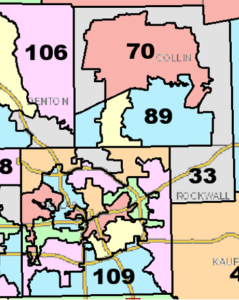
Redistricting alone has had a significant impact on our region’s districts. For a taste of how much our districts changed, compare the 2020 Texas House District map (left) to the new 2022 Texas House District map (right).


5 Ways for You to Learn More About Your Elected Officials

Now is the perfect time to start building relationships with your elected officials, as most are starting new terms and getting acquainted with their new districts.

Here are five steps you can take to get to know your elected officials, their work in the district and how they tend to vote.

  1. Figure out who represents you.
    The Texas Tribune has a great tool that allows you see which districts your home is in and how redistricting has changed your districts. To find your new representatives, visit this page and enter your address. Write down the numbers of your new congressional, state house and state senate districts. Then, look up the winners of these races on the Tribune’s election results page, and write down these names. Existing offices holders probably already have an office and phone number, which you can find on the websites of the U.S. House, Texas House and Texas Senate.*Do you need a convenient place to save the name and phone numbers of your elected officials? United Way has a new advocacy mini card where you can write down the name and capitol phone numbers of your elected officials so the information is easily accessible when you need to make calls about key community issues. Request your advocacy card here.
  2. Visit their campaign websites.
    All candidates and elected officials have a website so voters and the community can learn more about their background and priorities. Now that you have a list of your representatives, check out their websites, and note their involvement in the community, their philosophy on public service and their values. Campaign websites usually link to their social media pages, so take a little time to scroll through their posts, tweets and videos.
  3. Visit their official office website.
    Each member of the U.S. Congress and the Texas Legislature has a website that provides a map of their district, the address of their offices (generally one is at the Capitol and at least one other is in the district), and the committees they have been assigned. Knowing their committee membership gives you more information on the issues and legislation that they follow, are likely familiar with or are interested in. They generally have a staffer assigned to each committee who would be the best person for you to contact and/or meet with about a relevant issue.
  4. Sign up for their emails.
    Most offices send periodic emails to their constituents and other stakeholders on what the official has been working on. This may include how they voted on an important piece of legislation, meetings they have had with organizations from the district and events they are hosting in their district. These emails can also provide you with information on how to contact the elected official or their staffer if you would like to schedule a meeting with them. If they send out e-communication, you would be able to sign up for it on their campaign website or their capitol webpage.
  5. Follow them on social media.
    Social media is widely used by elected officials and their staff to share their thoughts on a topic, to highlight what they are working on or events they have attended, and to stay up-to-date on what’s happening with their colleagues and throughout their district, Texas or the U.S. The Texas Legislature has an official hashtag (#txlege), which you can use to find anything relevant to their. Most elected officials have accounts on social media platforms, including Twitter and Facebook. You can typically find links to their social media accounts on their campaign webpage or in their emails.

Learn More About Advocating with United Way

In the coming months, we hope you will join us as we speak up and speak out on the most pressing policy issues that impact education, income and health for our entire region. Here are some resources to ensure you feel comfortable and confident when advocating for lasting change:

School Resource Rooms Benefit the Entire Community

In schools across North Texas, unequal access to key resources can negatively affect children’s educational outcomes, preventing them from succeeding in school and potentially impacting the rest of their lives.

At United Way of Metropolitan Dallas, our work to improve access to education, income and health includes addressing under-resourced schools and communities. We have seen that students who have the resources and support necessary to succeed in school are more likely to secure good-paying jobs, which in turn enables them to afford quality health care for themselves and their families.

To combat the effects of under-resourced schools, we work with local school districts and corporate and community partners to establish campus-based community hubs in areas where a lack of investment has negatively affected schools. These resource rooms not only benefit students at the host campuses; they also serve thousands of students at nearby schools, as well as teachers, parents and other community members.

Read on to learn more about the impact of under-resourced schools on our children, how campus-based community hubs benefit the entire community, and how you can support this important work.

The Effect of Under-resourced Schools

When schools don’t have access to adequate resources, students suffer. These resources often include up-to-date school textbooks, smaller class sizes and one-on-one time with teachers, key instructional materials, and other necessities. In many areas of North Texas—especially those communities with a wealthy tax base—resources like these are a given. In places like Southern Dallas, they are less common.

Unfortunately, this situation plays out in schools across the country. In fact, America’s educational system is one of the most unequal in the developed world, according to The Brookings Institute.

That inequality disproportionately impacts children of color, as the Brookings researchers explain: “Educational outcomes for minority children are much more a function of their unequal access to key educational resources … Despite stark differences in funding, teacher quality, curriculum and class sizes, the prevailing view is that if students do not achieve, it is their own fault. If we are ever to get beyond the problem of the color line, we must confront and address these inequalities.”

In North Texas, we can see the impact of these differences by looking at the breakdown of educational outcomes in two key areas:

  • Third-grade reading proficiency. Children of color, on average, are less likely to read on grade level by third grade. While 62% of white third graders read proficiently, that number falls to 35% and 41%, respectively, for Black and Latinx students.
  • College readiness. Similarly, Black and Latinx students are much less likely to be college-ready when they graduate high school. While 42% of white high schoolers are prepared for college, only 15% of Black and 17% of Latinx students are.

These two metrics may seem unrelated, but they’re actually closely connected. According to a study from the American Educational Research Foundation, students who are both not reading proficiently by third grade and living in poverty are 13 times less likely to graduate from high school on time compared to their proficient, more affluent peers.

These disparities—which, again, are typically a result of unequal access to resources—can negatively impact an individual throughout their life, affecting how much they can earn in their career, their ability to access quality health care and, in turn, their children’s futures.

Improving Access to Education Resources

A key component of improving access to education, income and health—the building blocks of opportunity—involves addressing the problems impacting education in our region.

Community hub resource rooms are just one of the ways we work with our partners to address gaps in educational access. In the last year, through our Southern Dallas Thrives initiative, we opened two new resource rooms at Lincoln High School and South Oak Cliff High School, delivering key resources to more than 3,500 students, teachers and community members.

The rooms aren’t simply a space for students to gather; they are a hub of resources and services that have the power to open opportunities for everyone in the community. For example, our latest resource room project, at Lincoln High School, includes:

  • Multiple computers and printers with seating for group meetings or classes
  • A collection of free books through a partnership with the Dallas Public Library
  • Free resources including school uniforms, snack kits provided by GoodrCo., toiletries and hygiene products
  • Resources for the entire family, such as technology access, technical assistance and academic tutoring (plus, in the future, peer mentoring and financial literacy seminars)
  • A private room and office to be used for counseling and meetings with students, parents and teachers
  • A teachers’ lounge with a coffee and tea bar, comfortable seating for relaxation, and flexible tables for meetings

All of the services and resources support goals to improve student achievement and close opportunity gaps.

“School hours are already busy times for staff members, so you can imagine how challenging it can be for them to be confronted with a lack of basic needs that have a direct impact on student academics,” explains Cathy Kang, director of education and career success at United Way of Metropolitan Dallas. “By providing books, computers, printers, uniforms, food items, hygiene products and more, this room is intended to provide those wraparound services and resources so our educators can focus on academics. By rallying alongside partners like Dwell with Dignity, CGI and EY, United Way wanted the school to see that they have an entire community in their corner. We hope that this room will be a safe place for students and families to access needed resources and services to realize their full potential.”

For this project, Dwell with Dignity, an alum of our Social Innovation Accelerator, transformed the space with the help of dozens of dedicated volunteers who donated at least 80 hours in all. Meanwhile, CGI and EY provided generous support that made this project possible.

As the room reached completion, Lincoln High School Principal Johnna Weaver recognized how transformative it would be for her students.

“In addition to providing a space for our hardworking teachers to recharge, this room will be a welcoming place for our students and their families to access the critical resources and services that they deserve to reach their full potential,” she said. “We need to address needs beyond the classroom for students to be successful, and we know this resource room will do just that.”

Support Education in North Texas

With the support of volunteers and nonprofit and corporate partners, our targeted resource rooms are capitalizing on the community’s biggest opportunities and addressing the community’s biggest challenges. Together, we’re improving access to education for thousands of Southern Dallas residents every year.

This is measurable, lasting change that you can be a part of. Here are three ways you can get involved right now:

  • Give: Make a one-time or recurring donation of any size to invest in our initiatives that improve access to education right here in our community.
  • Advocate: The Texas Legislature convenes for its 88th session on Jan. 10, 2023. Join United Way in advocating for key bills that will impact education in North Texas. To get started, sign up for our Advocacy Alerts.
  • Volunteer: We frequently host volunteer programs that support local students and educators. Keep an eye on current and upcoming opportunities on our volunteer page.

Why Does United Way’s Key Education Goal Focus on Third-Grade Reading?

In 2020, United Way of Metropolitan Dallas collaborated with a wide variety of community partners to identify the goals that would guide our work and progress for the next 10 years. Our Aspire United 2030 goals are our North Star in the areas of education, income and health, keeping us focused on the key levers that will have the greatest community impact between now and 2030.

Our three main Aspire United 2030 goals are:

  • Increase by 50% the number of North Texas students reading on grade level by third grade
  • Increase by 20% the number of young adults in North Texas who earn a living wage
  • Increase to 90% the number of North Texans with access to affordable health insurance

Today we’re taking a closer look at our education goal—specifically, why the third-grade reading milestone is so important for a student’s success, both in school and post-graduation.

Third Grade: An Important Milestone in Education

Early-education experts often focus on third grade as an important learning milestone for students. Why? Because the ability to read opens the door to a child’s future, whether that takes the form of college, a career, the military or some other path. In fact, research indicates that children reading on grade level by the end of third grade are five times more likely to be college or career ready than their peers who don’t read on grade level.

Reading isn’t just great for children’s development, creativity and vocabulary. It’s the foundation for all other learning. When a student has strong reading skills, they are equipped to learn in other subjects, such as science, math, history and so much more. In fact, an estimated 85% of all curricula is taught by reading.

“Leading up to third grade, children are learning to read, but after that there’s a shift when they are reading to learn,” said Abigail Sharp, vice president of early childhood initiatives at United Way of Metropolitan Dallas. “Once children develop strong literacy skills, they are ready to begin learning and succeeding in every subject.”

Third-Grade Reading in North Texas Today

In North Texas, 50% of third graders read on grade level, or “proficiently.” Third-grade reading proficiency in our region varies significantly by race:

  • 35% of Black students read proficiently.
  • 41% of Latinx students read proficiently.
  • 62% of white students read proficiently.
  • 73% of Asian students read proficiently.

These figures are well below where we’d like them to be, especially since education is so closely tied to income and health later in life.

The Link Between Education, Income and Health

Education, income and health—what we call the building blocks of opportunity—aren’t standalone forces in an individual’s life. The three areas are overlapping and interdependent. And when young children aren’t set up for success in school—for example, by having strong reading skills—later in life it will impact their income and health.

The third-grade reading percentages above correspond to low college readiness statistics throughout North Texas, where more than 70% of students are not college-ready. Once again, the outlook is worse for minority students:

  • 15% of Black students are college-ready.
  • 17% of Latinx students are college-ready.
  • 42% of White students are college-ready.
  • 69% of Asian students are college-ready.

Graduates who aren’t ready for success in college (or a career) are more likely to end up with low-paying jobs. We see it play out today in North Texas, where 74% of young adults don’t earn a living wage.

Low incomes prevent many people in our community from achieving and maintaining good health, often because they can’t afford quality health insurance or get the care they need. In turn, poor health keeps adults from earning a steady income and prevents children from doing their best in school.

So, is third-grade reading an indicator of a person’s entire future? Of course not. But we do know that kids who enter school ready to learn are more likely to be “reading to learn” by third grade. And students who read proficiently are more likely to graduate from high school ready for college or career and living-wage jobs, when they can save for the future and cover the costs of health care—leading to success in school and life for their own children.

Join Us in Supporting Early Literacy

Research indicates that by the end of third grade, 74% of struggling readers won’t ever catch up. That’s why it’s so important for children to have literacy opportunities and exposure as early as possible.

At United Way of Metropolitan Dallas, we create, lead and invest in a variety of educational programs to improve third-grade reading proficiency in North Texas. We invite you to be part of the change by giving, advocating or volunteering to support early literacy in our community:

  • Give: Invest in United Way to support programs like Once Upon a Month™, which delivers age-appropriate children’s books to North Texas children every month to encourage language development and spark a love of reading.
  • Advocate: Join us in advocating for policy changes that will improve access to education for local students. Sign up for our Advocacy Alerts.
  • Volunteer: With United Day Reading Day coming up in March, this is a wonderful time to join us in promoting early literacy in our community. We invite you to volunteer to read to school children or sign up for a virtual book drive.